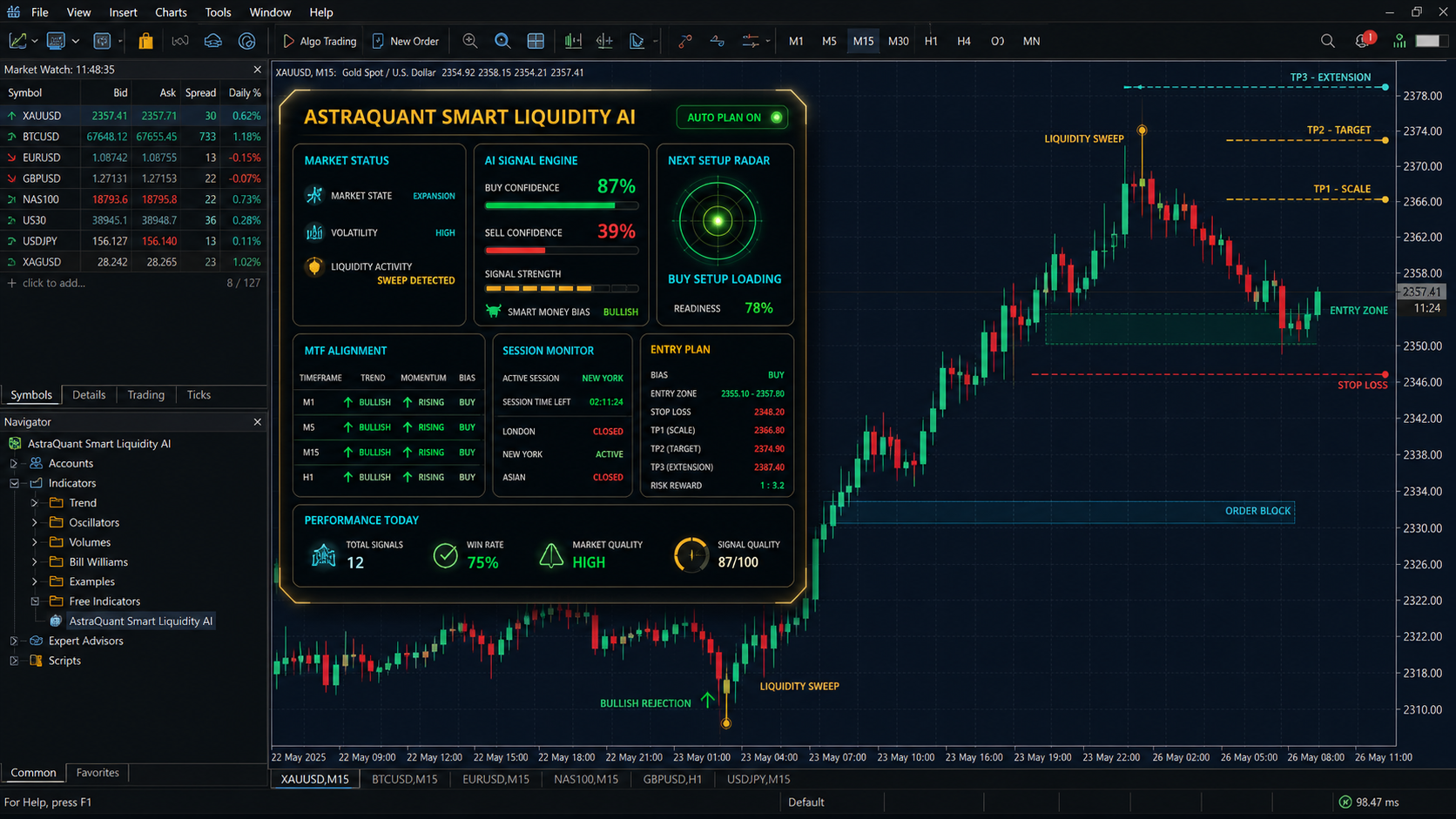
AstraQuant Smart Liquidity AI is not a tool I would describe with hype. It has a specific job, a specific type of trader, and a specific risk profile. This guide explains how I would evaluate it in a real MetaTrader workflow before trusting it with live money.
If you are comparing MT5 products from MQL5, the important question is not only “does it look good?” The better question is whether the tool fits your market, timeframe, account size, broker conditions, and decision process.
Why Liquidity Matters
Many retail traders look at support and resistance as clean lines. Real intraday movement is usually less polite. Price often moves beyond obvious highs or lows, triggers stops, pulls in breakout traders, and then decides whether the move is real or a trap. That is the environment AstraQuant Smart Liquidity AI is built around.
A liquidity indicator should not simply draw more objects. The useful part is context: where stops are likely resting, whether price reacted after taking liquidity, and whether the next move has enough structure to justify a trade. Without that context, liquidity language becomes another way to overtrade.
How I Would Use It on a Chart
I would start from the higher timeframe and mark the most obvious swing points. Then I would move to the execution timeframe and watch how price behaves near those areas. A sweep by itself is not an entry. The important part is the reaction after the sweep: displacement, rejection, structure shift, or failure to continue.
AstraQuant Smart Liquidity AI can help organize that process by making the liquidity event easier to see. The trader still needs to ask the professional questions: is this a stop hunt or a genuine breakout, is the session active enough, and is there room to target the next logical zone?
Best Use Cases
The indicator is most useful for traders who already think in terms of market structure. Gold, indices, and major forex pairs often create clear liquidity pools around session highs, previous-day levels, and obvious swing points. Those areas are where this kind of tool can add value.
It is less useful if a trader wants simple buy and sell arrows without understanding price context. Liquidity tools require patience. Many sweeps are not trades. A good trader waits for location, reaction, and risk-to-reward to line up.
Risk and Confirmation
The biggest risk with liquidity trading is entering immediately after a level is taken. Sometimes the sweep is only the beginning of continuation. That is why confirmation matters: candle close, structure shift, momentum change, or a clear rejection pattern. The stop should be placed where the trade idea is invalid, not where it feels comfortable.
I would also avoid using liquidity alone. Pair it with session timing, higher-timeframe bias, and volatility awareness. If the market is flat, a liquidity sweep may not travel far enough to justify the risk.
Why This Can Create Search Value
A trader searching for a liquidity sweep indicator usually wants more than a product name. They want to understand how to avoid false breakouts, how to read stop hunts, and how to build a repeatable entry process. That is why this article focuses on workflow, not just features.
A Simple Liquidity Sweep Checklist
Before treating a sweep as useful, I would check five things: was the level obvious, did price take it with intent, did the candle close back inside or continue, is the higher-timeframe bias aligned, and is there enough room to the next target? If those questions are not answered, the trade is probably based on excitement rather than structure.
This is why liquidity tools should support a checklist instead of replacing judgment. The chart can show the event, but the trader must decide whether the event has enough quality to justify risk.
Before You Buy on MQL5
Use the official seller catalog to confirm current price, screenshots, comments, demo availability, version history, and supported platform. I use seller-list links because MQL5 product URLs and availability can change over time.
My recommendation is simple: read the guide, test the demo if available, start with conservative settings, and judge the product from process quality rather than one lucky trading day.
Frequently Asked Questions
Is AstraQuant Smart Liquidity AI a signal indicator?
It is better understood as a liquidity and context tool. A sweep or zone should still be confirmed with price action and risk rules.
Does it work only on gold?
The concept can apply to many MT5 markets, but each symbol should be tested separately because volatility behavior differs.
Can beginners use liquidity tools?
Yes, but beginners should first learn swing highs, swing lows, session highs, and basic market structure.
View AstraQuant Smart Liquidity AI on MQL5
Open the official seller catalog for current pricing, screenshots, comments, demos, and installation options.
Open Seller List ->