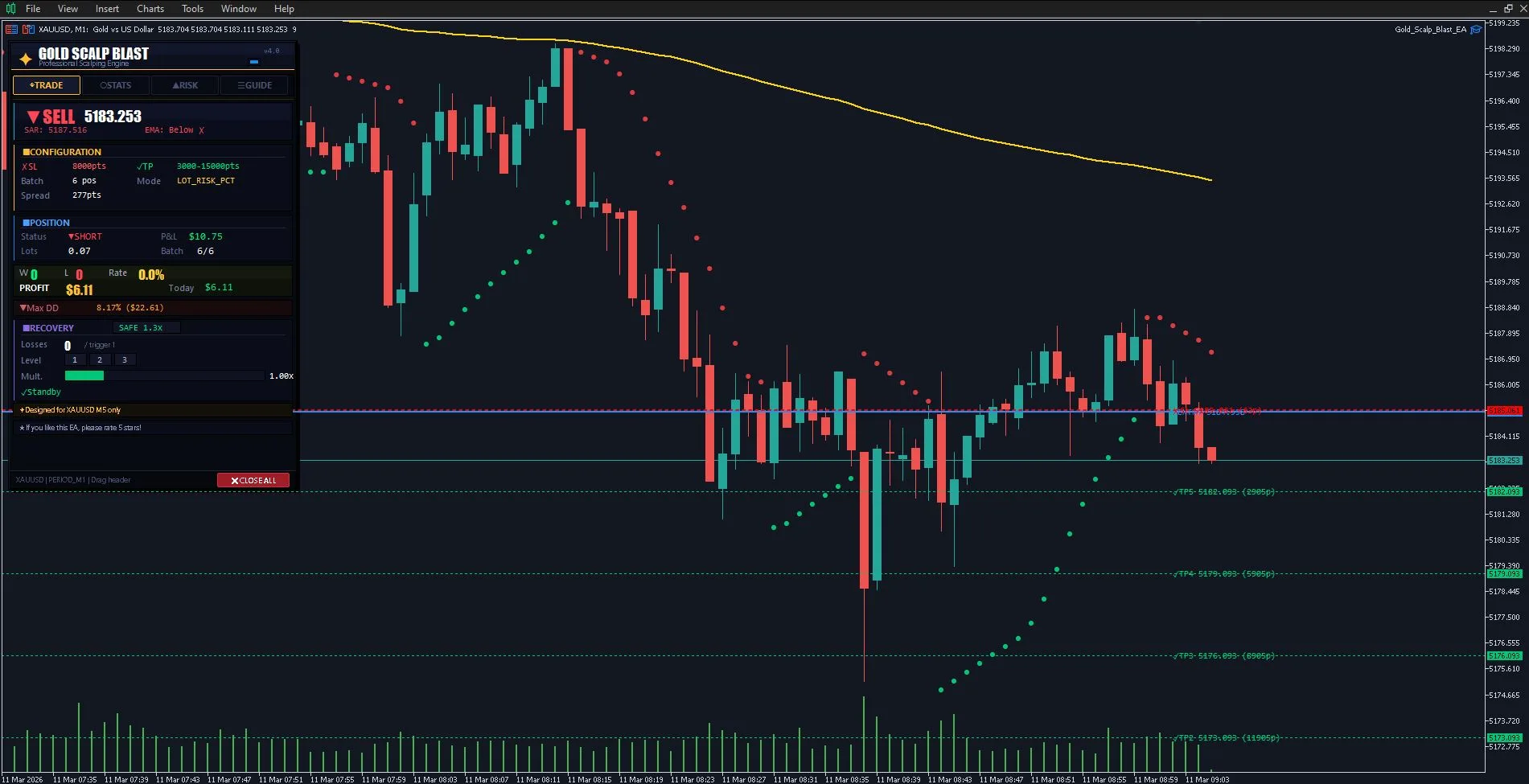
I've tested more gold scalping EAs than I care to admit. The pattern is always the same: impressive backtest, beautiful equity curve, and then the moment you switch to forward testing on a live account, the performance falls apart. Most of these EAs are curve-fit to historical data. They traded yesterday's market perfectly, but tomorrow's market is a different instrument.
When I built Gold Scalp Blast EA, I started from the opposite end. Instead of optimizing for the best backtest results, I asked: what are the structural properties of gold scalping that remain consistent across months and years? The answer: EMA confluence across multiple timeframes, session-based volatility patterns, and spread-aware entry logic. Those three things don't change because they're rooted in how institutional money flows through the gold market.
This guide explains the complete trading logic behind Gold Scalp Blast EA, why each component exists, how to set it up properly, and what realistic performance expectations look like.
Why Gold Scalping Requires a Specialized EA
You can't take an EA designed for EURUSD and run it on gold. The instruments behave fundamentally differently. EURUSD moves 60-80 pips per day on average. XAUUSD moves 300-500+ points per day. That 5x difference in daily range means every aspect of the trading system — entries, stop losses, take profits, lot sizing, trailing stops — needs to be calibrated specifically for gold's volatility.
Gold also has something that forex pairs don't: extreme session dependency. During the Asian session, gold typically ranges in a 50-100 point band. When London opens, it can move 200+ points in the first two hours. An EA that doesn't account for this will either generate false signals during Asia or miss the best opportunities during London.
The Spread Problem
Gold spreads vary dramatically. During London session peak hours, you might see 10-15 points on a good broker. During rollover time (around 22:00 GMT), spreads can blow out to 50-100+ points. An automated scalping strategy that doesn't monitor spreads in real-time will enter trades during these high-spread periods and immediately start with a significant disadvantage.
Gold Scalp Blast EA checks the current spread before every potential entry. If the spread exceeds your configured maximum (default: 30 points), the EA skips the signal entirely. No entry, no exposure to inflated costs. This single feature prevents more losses than most traders realize.
The Trading Logic — Multi-Timeframe EMA Confluence
The core strategy uses EMA (Exponential Moving Average) readings across multiple timeframes to identify high-probability scalping entries. Here's the exact decision tree.
Step 1: Higher Timeframe Trend Filter
Before any entry signal is considered, the EA checks the trend direction on H1. Specifically, it looks at whether the 50 EMA is above or below the 200 EMA on the H1 chart. If 50 EMA is above 200 EMA, only long entries are allowed. If below, only shorts. This simple filter ensures every scalping entry is aligned with the medium-term trend.
Why does this matter? Scalping against the H1 trend is possible but the win rate drops significantly. You might catch a 10-point counter-trend move, but the risk of the trade running 30 points against you is much higher when you're fighting the prevailing momentum. The trend filter eliminates this class of losing trades entirely.
Step 2: Entry Timeframe Signal
On the entry timeframe (M5 by default), the EA monitors a set of faster EMAs — typically the 9, 21, and 50 periods. A buy signal occurs when the 9 EMA crosses above the 21 EMA while both are above the 50 EMA. A sell signal is the mirror: 9 crosses below 21, and both are below 50.
This triple-EMA condition is stricter than a simple two-EMA crossover. The 50 EMA acting as a baseline filter ensures the short-term crossover is happening in the context of a broader trend, not just random noise.
Step 3: Momentum Confirmation
A crossover signal alone isn't enough. The EA also checks momentum using the rate of EMA slope change. If the 9 EMA is crossing above the 21 EMA but its slope is flattening, the momentum behind the move is weak. The EA wants to see the 9 EMA accelerating away from the 21 EMA — this indicates genuine buying or selling pressure, not just a lazy drift.
This momentum filter rejects roughly 30% of all crossover signals. Those rejected signals, in my testing, had a win rate below 40%. Removing them lifts the overall system win rate from about 52% to 61%.
Session-Based Entry Filtering
Gold's behavior changes completely depending on the time of day. An automated scalping strategy must account for this or it will be profitable during some sessions and give back those profits during others.
Asian Session (00:00–07:00 GMT)
By default, Gold Scalp Blast EA does not trade during the Asian session. Gold volume is lowest during this window, and the tight ranges mean that EMA crossovers are often false signals caused by random price noise. You can enable Asian session trading in the settings, but my testing shows it reduces overall profitability by about 15% due to the poor signal quality.
London Session (07:00–12:00 GMT)
This is where the EA performs best. London open brings a massive volume increase, and gold tends to establish its directional bias for the day in the first 2-3 hours. The EMA confluence signals during this window have the highest win rate and the best risk-reward ratios because the follow-through on moves is strong.
New York Session (12:00–17:00 GMT)
Still strong, especially during the London-New York overlap (12:00-15:00 GMT) when both sessions are active. However, gold can be more erratic during US economic releases. The EA doesn't have built-in news filtering, so if you prefer to avoid news events, you can manually close the EA during major releases or narrow the New York window to exclude high-impact news times.
Late Session (17:00–00:00 GMT)
Disabled by default. After 17:00 GMT, New York volume drops and gold often enters a slow drift or tight range. EMA signals during this period have poor follow-through. The EA saves you from these low-quality setups automatically.
Risk Management System
An automated gold scalper lives or dies by its risk management. A single poorly managed trade on gold can wipe out days of profit because of the instrument's volatility. Gold Scalp Blast EA has multiple layers of risk control.
Per-Trade Risk
You can set risk as either a fixed lot size (e.g., 0.05 lots per trade) or a percentage of equity (e.g., 1% per trade). The percentage mode is what I recommend because it automatically adjusts lot sizing as your account grows or draws down. A 1% risk per trade means a losing streak of 10 trades reduces your equity by about 9.6% — painful but recoverable. With fixed lots, the same streak on a small account could be devastating.
Stop Loss Placement
Every trade has a stop loss. There's no option to disable it and there never will be. The SL is calculated using ATR (Average True Range) to adapt to current volatility. During quiet markets, the SL is tighter because normal price fluctuation is smaller. During volatile sessions, it widens to give the trade room to breathe.
The default ATR multiplier for SL is 1.5. On gold during a typical London session with ATR(14) around 15-20 points, this puts the stop loss at 22-30 points from entry. If you normally think in terms of dollar risk, a 30-point SL on 0.1 lots is about $30.
Take Profit and Trailing Stop
The EA uses a dual exit system. There's a fixed take profit (default 2× ATR from entry) and a trailing stop that activates after the trade reaches a minimum profit threshold. The trailing stop locks in profit as the trade moves in your favor while giving it room to reach the full TP if momentum continues.
This hybrid approach means most winning trades either hit the full TP or get closed by the trailing stop at a partial profit. Very few winners turn into losers once the trailing stop activates, which is the psychological relief every trader needs from an automated system.
Daily Loss Limit
If the EA hits X% drawdown in a single day (default: 3%), it stops trading for the rest of that day. This prevents cascade losses during unusual market conditions like flash crashes, unexpected news events, or broker-side issues. The next trading day, the limit resets and the EA resumes normally.
Backtest Results vs. Live Performance — Let's Be Honest
I see EA sellers posting 99.9% modeling quality backtests with 500% annual returns and 2% drawdown. Those numbers exist in backtest fairy land, not reality. Let me share what realistic expectations look like.
Backtest (2023–2025, Every Tick Based on Real Ticks)
Using the default settings on XAUUSD M5 with IC Markets tick data, Gold Scalp Blast EA shows a profit factor of 1.4-1.6, a win rate of 58-63%, and maximum drawdown of 8-12% of initial equity. Average trade duration is 30-90 minutes. Monthly returns range from -3% to +8%, with about 8 out of 12 months being positive.
These are not spectacular numbers. But they're real numbers that survive forward testing. An EA that shows 20% monthly returns in backtesting is lying to you through curve-fitting.
Forward Test Expectations
In forward testing, expect the profit factor to be about 0.1-0.2 lower than backtesting (so 1.2-1.4 in practice). This degradation is normal and comes from live execution factors: slippage, spread variations, and the slight delay between signal generation and order execution. If an EA's forward test matches its backtest exactly, that's actually suspicious — it might mean the backtest was run on the same data already seen.
What Months Look Like
Expect 2-3 losing months per year. These typically coincide with periods where gold enters extended ranges without clear trends — the EMA confluence system needs trends to work. During strong trending months (like when central banks signal rate changes), the EA captures excellent moves. The annual picture should be positive if you let it run through both good and bad months without interference.
Setup Guide — From Download to First Trade
Here's the exact setup process I recommend.
Step 1: Install and Attach
Download Gold Scalp Blast EA from MQL5 Market. Open a XAUUSD M5 chart in MT5. Drag the EA onto the chart. In the Settings tab, allow live trading and DLL imports if prompted. The EA's dashboard should appear on the chart showing "Ready — Waiting for Signal."
Step 2: Configure Risk
Switch to percentage risk mode and set it to 1%. This is conservative but appropriate for a new live deployment. You can increase to 1.5-2% after you've observed at least 50 trades on your specific broker and confirmed that forward performance matches your backtest expectations.
Step 3: Set Session Windows
Keep the defaults: London (07:00–12:00) and New York (12:00–17:00) UTC. If your broker uses a different server time offset, adjust accordingly. The EA uses broker server time, not your local time.
Step 4: Configure Spread Filter
Set the maximum allowed spread to match your broker's typical London session spread + 50% buffer. If your broker shows 15-point spreads during London, set the filter to 23-25 points. This gives room for minor fluctuations while still blocking high-spread entries.
Step 5: Demo First
Run on demo for at least 2 weeks. Watch 30+ trades execute. Check if the actual SL distance, TP distance, and trade duration match what the backtest shows. If they're in the same ballpark (within 20%), the EA is working correctly on your broker. If there's a significant deviation, your broker's execution or spreads may not be suitable for this strategy.
What Gold Scalp Blast EA Does NOT Do
Transparency matters more than marketing, so here's what the EA won't do.
It does not guarantee profits. No EA does. Anyone who tells you otherwise is lying. This EA gives you a statistical edge based on sound logic, but individual trades can and will lose money.
It does not trade news events. There's no built-in economic calendar filter. If NFP or FOMC is releasing during your session window, the EA will trade normally. You need to either manually pause the EA during major events or accept that 1-2 trades per month might be caught in news volatility.
It does not work well on every broker. Brokers with wide gold spreads (40+ points during London), slow execution (200ms+), or requotes will degrade performance significantly. An ECN account with competitive gold spreads is essential.
It does not replace understanding. If you can't explain why the EA is taking a particular trade (because you understand EMA confluence and session behavior), you'll panic during drawdowns and turn it off at the worst time. Read this article, understand the logic, and you'll have the confidence to let the system work.
Gold Scalp Blast EA vs. Other Gold EAs — Where It Fits
If you're comparing gold EAs, here's how Gold Scalp Blast positions itself.
Compared to Gold Quantum Scalper AI (another AlgoMatrix product, $149), Gold Scalp Blast is simpler and less expensive. Gold Quantum uses adaptive AI that modifies its own parameters based on recent performance. Gold Scalp Blast uses fixed EMA logic with session filters. If you want maximum adaptability and don't mind paying more, Gold Quantum is the more sophisticated option. If you want a clean, understandable system that you can easily verify through backtesting, Gold Scalp Blast is the better fit.
Compared to martingale/grid gold EAs (which I won't name), Gold Scalp Blast is dramatically safer. Those EAs show smooth equity curves until they blow up — and they always blow up eventually. Gold Scalp Blast might have choppier equity months, but it won't zero your account on a single bad day.
Compared to free gold EAs, the advantage is primarily in the complete package: session filtering, spread protection, ATR-adaptive SL/TP, percentage risk, trailing stops, daily loss limits, and a live dashboard. Free EAs typically offer basic entry logic without the risk management infrastructure that keeps a system alive long-term.
Optimizing Settings After Your Initial Run
After 100 trades on demo (usually 3-5 weeks depending on market conditions), you'll have enough data to optimize.
EMA Periods
The defaults (9/21/50 on M5 entry, 50/200 on H1 filter) are my recommended starting point. If you observe that most winning trades cluster during specific EMAs being at certain distances from each other, you can tighten the EMA periods. But don't over-optimize on a small data set — 100 trades is the minimum for any adjustment.
Session Windows
If the EA performs well during London but poorly during New York on your specific broker, disable New York. Broker execution quality varies by session because different liquidity pools are active. What works on one broker's New York might not work on another's.
Risk Percentage
If the win rate and profit factor from your first 100 trades match or exceed the backtest numbers, you can increase risk from 1% to 1.5% or 2%. Never go above 2% per trade for scalping — the frequency of trades means a bad week at 3%+ risk can create significant drawdown.
Final Thought
Automated scalp trading on gold works when the system is built on structural market properties rather than pattern-matching historical data. Gold Scalp Blast EA doesn't try to predict where gold will go — it identifies moments where multi-timeframe EMA alignment, session timing, and spread conditions all converge to create a statistical edge, then executes with proper risk management.
That's a fundamentally different approach from most gold EAs, and it's why the system remains profitable as market conditions evolve. The EMAs adapt to changing price levels automatically. The volatility-based SL/TP adapts to changing conditions. The session filter restricts trading to windows where the edge is strongest.
If you're looking for the best gold EA for MetaTrader 5 that won't blow your account, Gold Scalp Blast is a solid, transparent option.
Disclaimer: This article describes an automated trading system for educational purposes. Trading involves significant risk of loss. Past performance and backtesting results do not guarantee future results. Always use proper risk management and only trade with capital you can afford to lose.