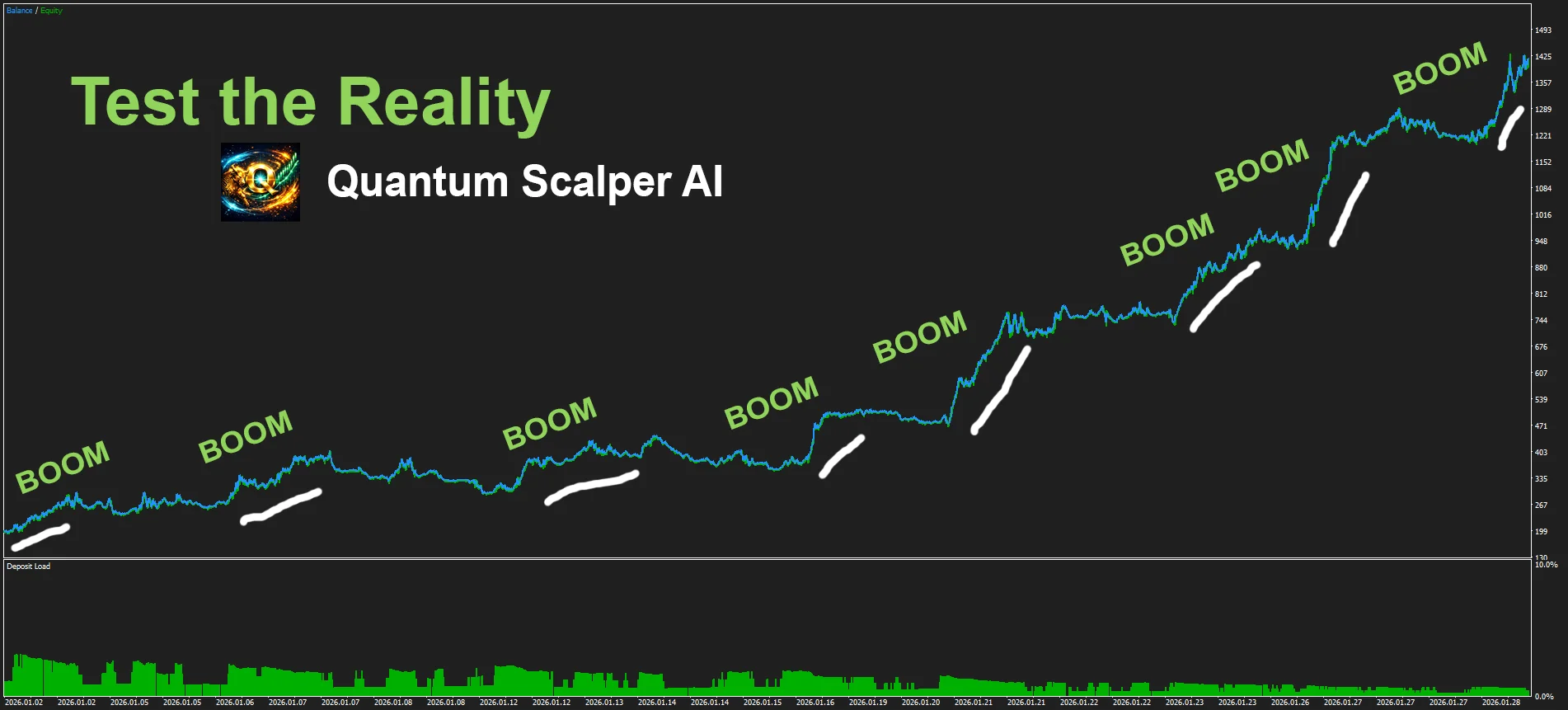
I've been building trading tools for MetaTrader 5 for a while now. Indicators that spot signals, dashboards that scan markets, utilities that manage positions. But the one thing that always nagged me was this: most Expert Advisors have an expiration date. They work beautifully for three months, then the market shifts and the equity curve nosedives.
I experienced this firsthand with my earlier EA work. I'd optimize parameters on two years of XAUUSD data, get incredible backtest results, deploy it on a live account - and within weeks, the market character would change. Volatility would spike or flatten, sessions would shift, and the EA that looked perfect in the strategy tester would start bleeding money.
That frustration is what drove me to build Gold Quantum Scalper AI. Not another static scalping robot, but an EA that actually watches its own performance and adjusts itself. An EA that treats its own trade history as data, not just as entries in a log file.
The Core Problem with Traditional Gold EAs
Let me explain the problem more concretely. Say you optimize an EA and find that a 4000-point stop loss and a 3200-point TP1 work great on XAUUSD M5 during backtesting. You deploy it. Gold starts trending with $50+ daily ranges instead of $30. Suddenly your 4000-point SL is getting hit more often because the normal noise level has increased. Your TP1 at 3200 points is getting hit less because the retracements are deeper before continuation.
A traditional EA doesn't know this is happening. It just keeps executing the same parameters until you notice the drawdown in your account, manually re-optimize, and update the settings. By then, you've already lost a chunk of your capital.
What if the EA could detect this shift on its own? What if it could look at its recent trade results, realize that SL is getting hit too frequently, and widen it slightly? Or notice that TP1 is being reached easily and push TP2 further to capture more of the move?
That's exactly what Gold Quantum Scalper AI does.
How the ZigZag Strategy Engine Works
At its foundation, Gold Quantum Scalper AI uses an ATR-based ZigZag algorithm to detect market structure. If you've read my article on ZigZag pattern trading, you know I'm a fan of using ZigZag for structural analysis rather than raw signal generation.
The EA calculates ATR (Average True Range) to understand current volatility, then identifies significant swing highs and swing lows. When the ZigZag structure confirms a reversal - meaning price has moved a meaningful distance from the last swing point - the EA evaluates whether to enter a trade.
But here's where it differs from a simple ZigZag indicator:
- Minimum bar filter - prevents rapid-fire signals during choppy price action. You can set a minimum number of bars between signals, so the EA doesn't chase every micro-swing.
- MA trend filter - optionally requires price to be on the right side of a moving average before entering. This keeps the EA trading with the broader trend instead of catching every counter-trend bounce.
- Spread filter - automatically pauses trading when the spread exceeds your threshold. Gold spreads can widen dramatically during news events or low-liquidity sessions, and this filter keeps the EA from entering at terrible prices.
- Session filter - restricts trading to specific hours (UTC), so you can limit the EA to London and New York sessions where gold actually moves with conviction.
The 3-Tier Take Profit System
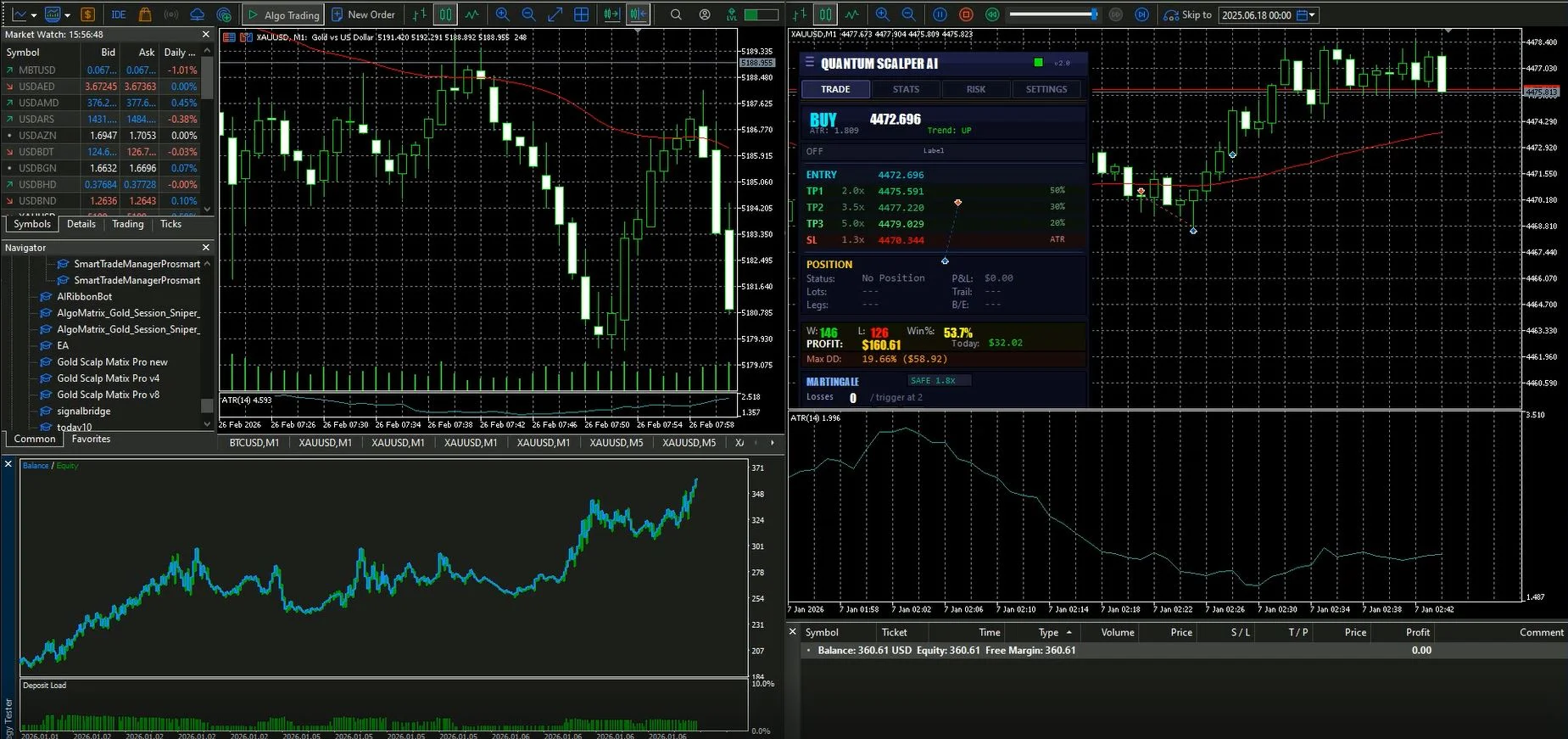
One of the most important lessons I've learned trading gold is that single-target exits leave money on the table. If you set one TP and price blows past it by 200 pips, you feel like you left half the trade behind. If you don't set a TP and price reverses, you watch your profit evaporate.
Gold Quantum Scalper AI splits every trade into three legs with separate take-profit levels:
- TP1 (50% of position) - the quick win. This is set relatively tight, designed to lock in profit early and reduce the psychological pressure of the remaining position.
- TP2 (30% of position) - the medium target. Once TP1 hits, the stop loss moves to breakeven on the remaining legs. TP2 captures the meat of the move.
- TP3 (20% of position) - the runner. This is the portion that stays open for the extended move. It's where the big wins come from when gold decides to trend hard.
The split percentages are fully customizable. Some traders prefer 40/30/30, others like 60/20/20. The key insight is that you're not betting the entire position on a single price target. You're managing the trade as a portfolio of three separate positions with different risk/reward profiles.
Each TP level can be calculated using either ATR multipliers (adaptive to current volatility) or fixed point values (for traders who prefer optimization-based targets). In ATR mode, TP1 defaults to 2x ATR, TP2 to 3.5x ATR, and TP3 to 5x ATR - but the auto-adapt engine can adjust these in real time.
The Intelligent Auto-Adapt Engine - The Brain
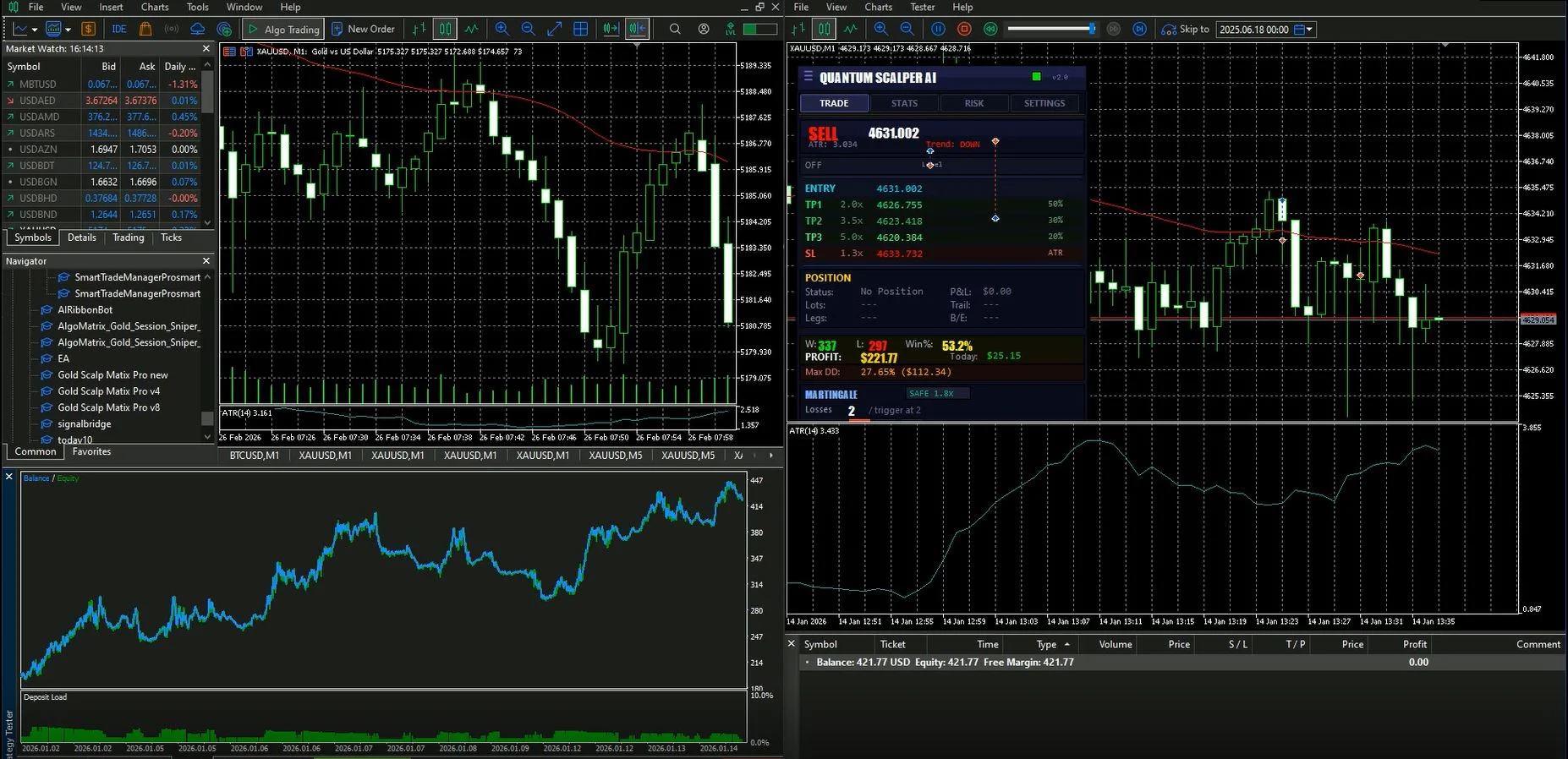
This is the feature I'm most proud of, and the reason I call it "Quantum Scalper AI" instead of just another scalping EA.
Every closed trade gets recorded into a circular buffer of trade history. The EA tracks not just whether the trade won or lost, but:
- What was the ATR at entry?
- What was the SL distance in points?
- What was the TP distance?
- Did price reach TP1? TP2? TP3?
- What was the maximum favorable excursion (how far did price go in your favor)?
- What was the maximum adverse excursion (how far did price go against you)?
- What market condition was detected at entry - normal, volatile, trending, or ranging?
Every N trades (configurable, default is 15), the auto-adapt engine runs an analysis of all this data. It calculates a "performance score" and determines whether the current SL/TP parameters are optimal for the recent market conditions.
If the data shows that stops are getting hit too often relative to the ATR environment, the engine widens SL slightly. If TP1 is barely being reached, it tightens. If the market has shifted from trending to ranging, it adjusts the ZigZag amplitude to filter more noise.
The maximum adjustment is capped at ±30% of the original base parameters. This prevents the engine from drifting too far from your original optimization and creating wild, untested parameter combinations. It also includes an anti-oscillation mechanism - if the engine keeps flip-flopping between widening and tightening, it pauses adaptation until a clearer trend in performance emerges.
Win Rate Adaptive Lot Sizing
Here's another concept that I haven't seen in many commercial EAs. The idea is simple: when the EA is winning consistently, increase the lot size slightly. When it's going through a losing streak, reduce it.
Gold Quantum Scalper AI tracks the win rate over a rolling window of recent trades (default: last 20). Based on this rolling win rate, it automatically adjusts lot sizing across three tiers:
- Below 50% win rate - minimum lot (0.01 by default). The EA is in a rough patch, so it reduces exposure.
- 50-53% win rate - medium lot (0.02). Performance is acceptable, moderate sizing.
- Above 53% win rate - increased lot (0.03). The EA is in a hot streak, capitalize on it.
All thresholds and lot sizes are fully configurable. The point isn't the specific numbers - it's the concept of dynamically scaling position size based on recent performance rather than using a static lot regardless of whether the EA is in sync with the market or struggling.
The Recovery System - Controlled, Not Reckless
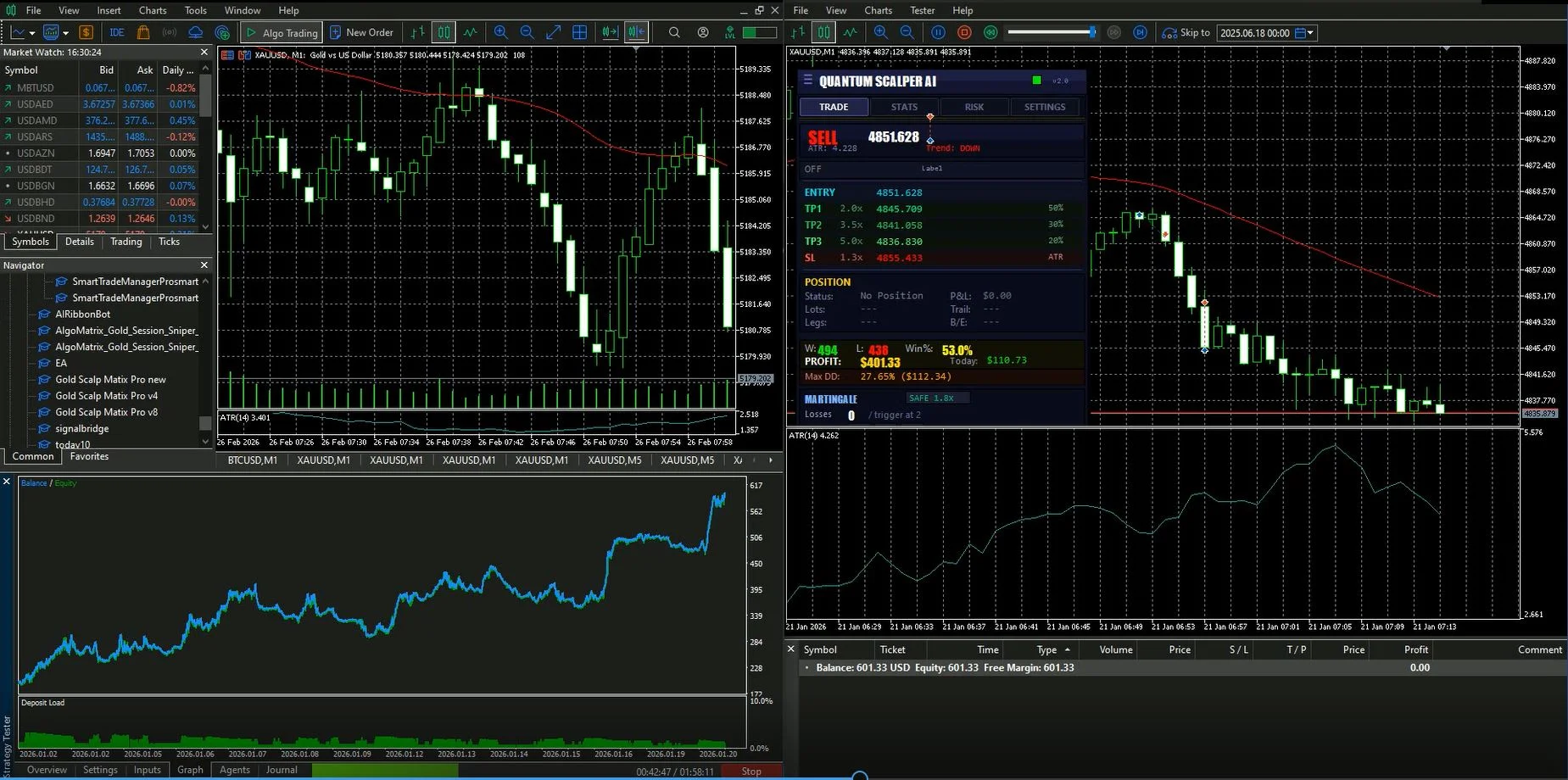
I need to talk about martingale. I know it's a dirty word in trading. For good reason - pure martingale (doubling lot size after every loss) is a guaranteed way to blow your account eventually. The math simply doesn't work over infinite trades.
But controlled recovery - where you increase lot size modestly after consecutive losses, with hard caps and safety limits - can actually improve overall performance when implemented responsibly.
Gold Quantum Scalper AI offers three recovery modes:
- Safe (1.8x) - after 2 consecutive losses, the next trade uses 1.8x the normal lot. If that loses too, the next uses 1.8x again, up to 3 recovery levels.
- Moderate (2.0x) - same logic, 2.0x multiplier.
- Aggressive (2.5x) - for traders with larger accounts and higher risk tolerance.
What makes this safe rather than suicidal:
- Maximum cumulative risk is capped at 6% of the account.
- Maximum recovery levels are limited (default 3 - the EA won't keep doubling forever).
- Daily loss limit halts all trading if the account drops more than 12% in a single day.
- Equity stop activates if total equity drops below 80% of the starting balance.
- If TP2 is hit during a recovery trade, the recovery system resets - you've recovered enough.
You can also disable recovery entirely (mode: Off). Some traders prefer flat position sizing, and that's a completely valid choice. The system is there for those who want it, not forced on anyone.
Smart Trailing Stop Modes
Gold is volatile. A trailing stop that works on EUR/USD will get you stopped out constantly on XAUUSD. So I built five different trailing modes into the EA:
- No Trailing - fixed SL, let the TP targets handle exits. Simple and clean.
- Breakeven Only - once price reaches a certain percentage of TP1 distance, SL moves to breakeven. No further trailing. Good for traders who want protection without complexity.
- Step Trailing - classic trailing stop that moves in defined steps. After TP1 is hit, the stop trails by X points every time price moves Y points in your favor.
- ATR-Based Trailing - the trailing distance is calculated from ATR, so it automatically widens during volatile periods and tightens during calm periods. This is the mode I personally prefer.
- Intelligent Mode - no TP targets at all. The EA relies entirely on the trailing stop to capture the full move. It activates after price moves 1.5x ATR in your favor, then trails at 1.2x ATR. This mode is for traders who believe in letting winners run.
The Equity Curve Auto-Reverse - Experimental but Interesting
This is a feature I built for advanced users who understand what they're doing. The concept comes from systematic trading research: if your equity curve is trending downward (below its own moving average), your strategy is out of sync with the market. Instead of stopping completely, what if you reversed the signals?
When auto-reverse is enabled, the EA monitors its own equity curve. If performance deteriorates significantly - specifically, if the intra-day peak drawdown exceeds a configurable threshold - the EA flips its signals. What would have been a buy becomes a sell, and vice versa.
The theory is that if the EA is consistently wrong, doing the opposite should be consistently right. In practice, it's more nuanced than that. There's a hysteresis buffer to prevent whipsaw (constant flipping), and a halt mechanism that stops the EA entirely if the reversed mode doesn't recover within N trades.
I keep this disabled by default. It's an experimental concept that works better in some market regimes than others. But for traders who want to explore it, the framework is there.
The Info Panel - Not Just Pretty Numbers
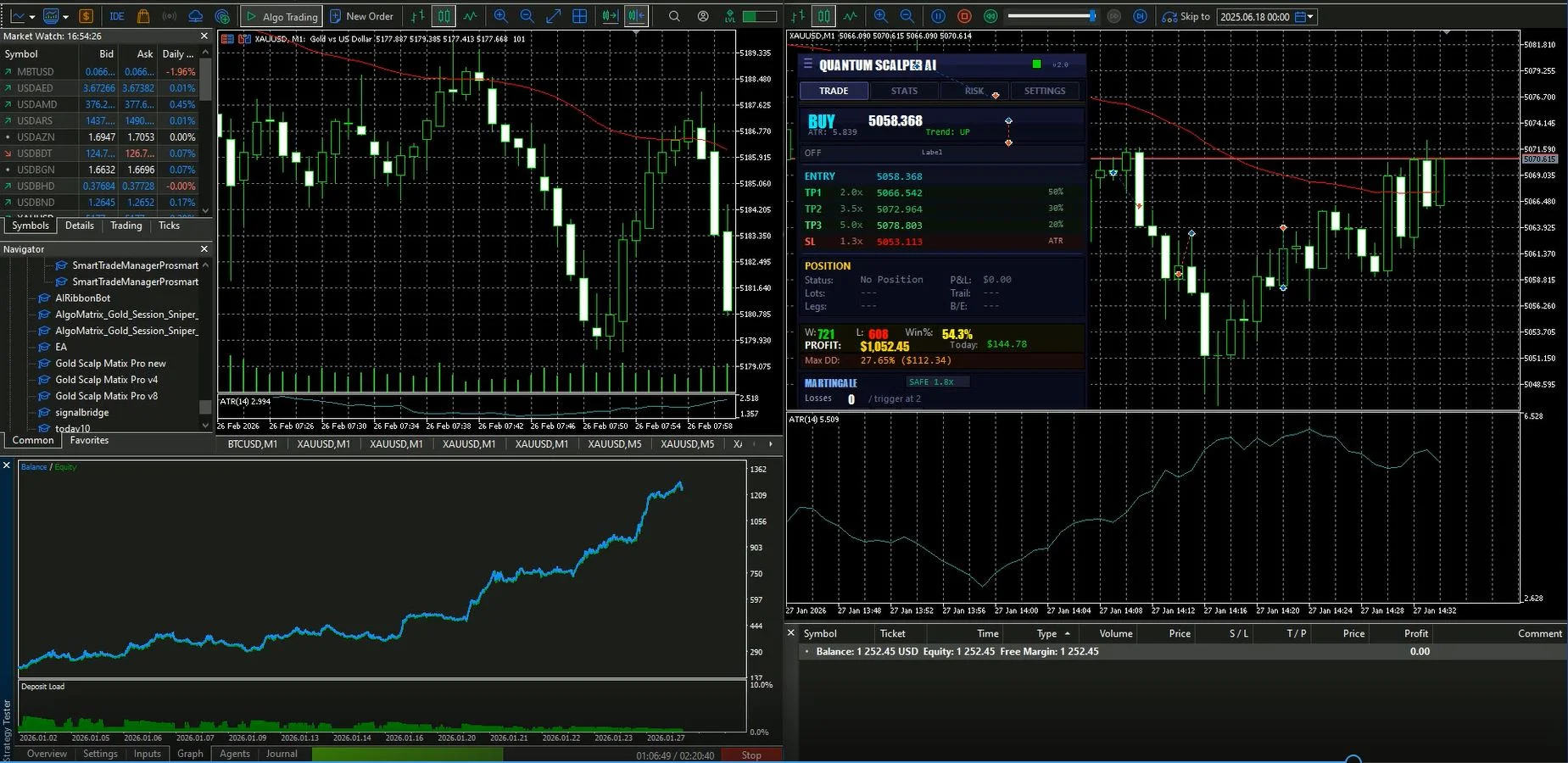
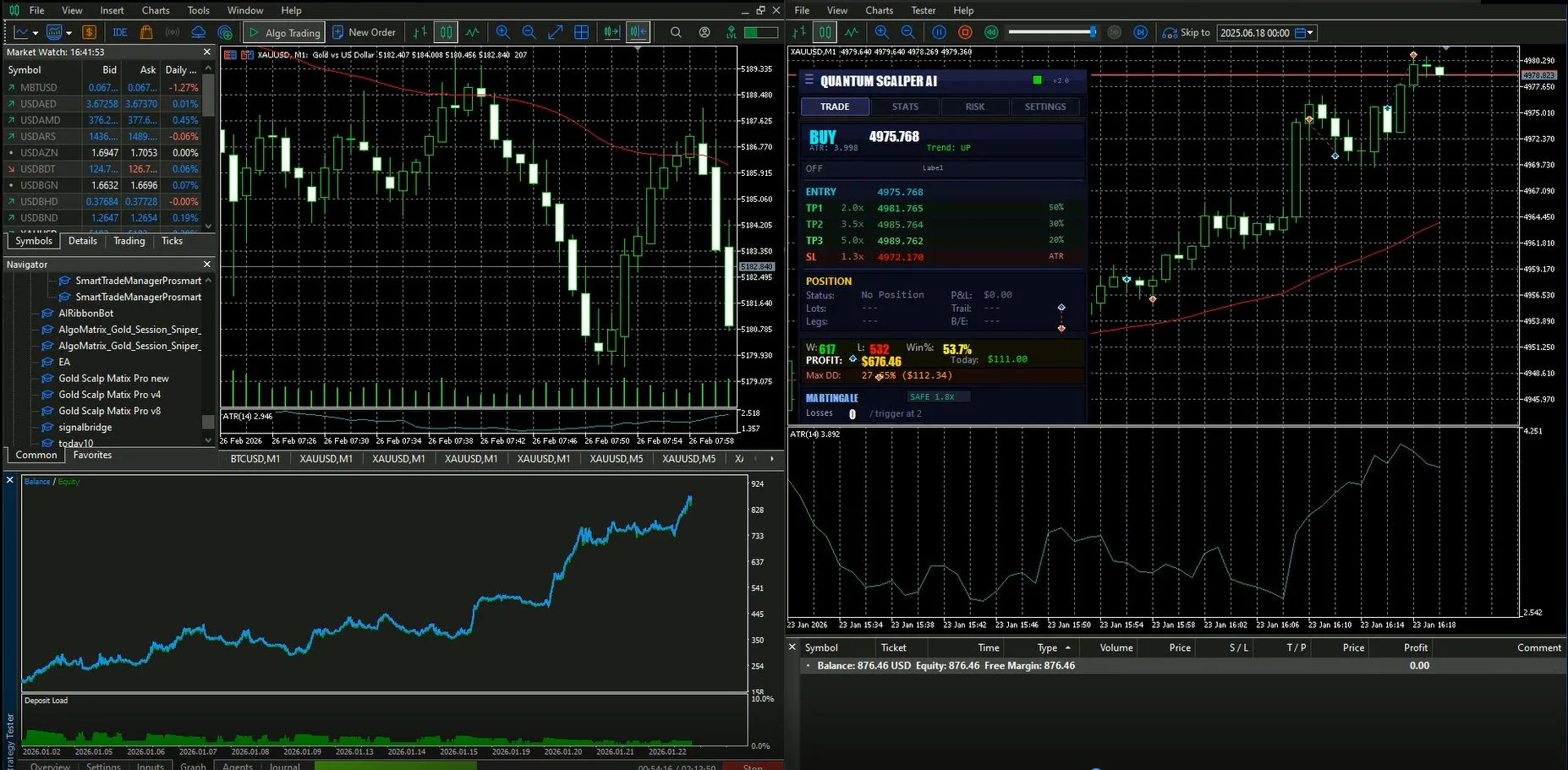
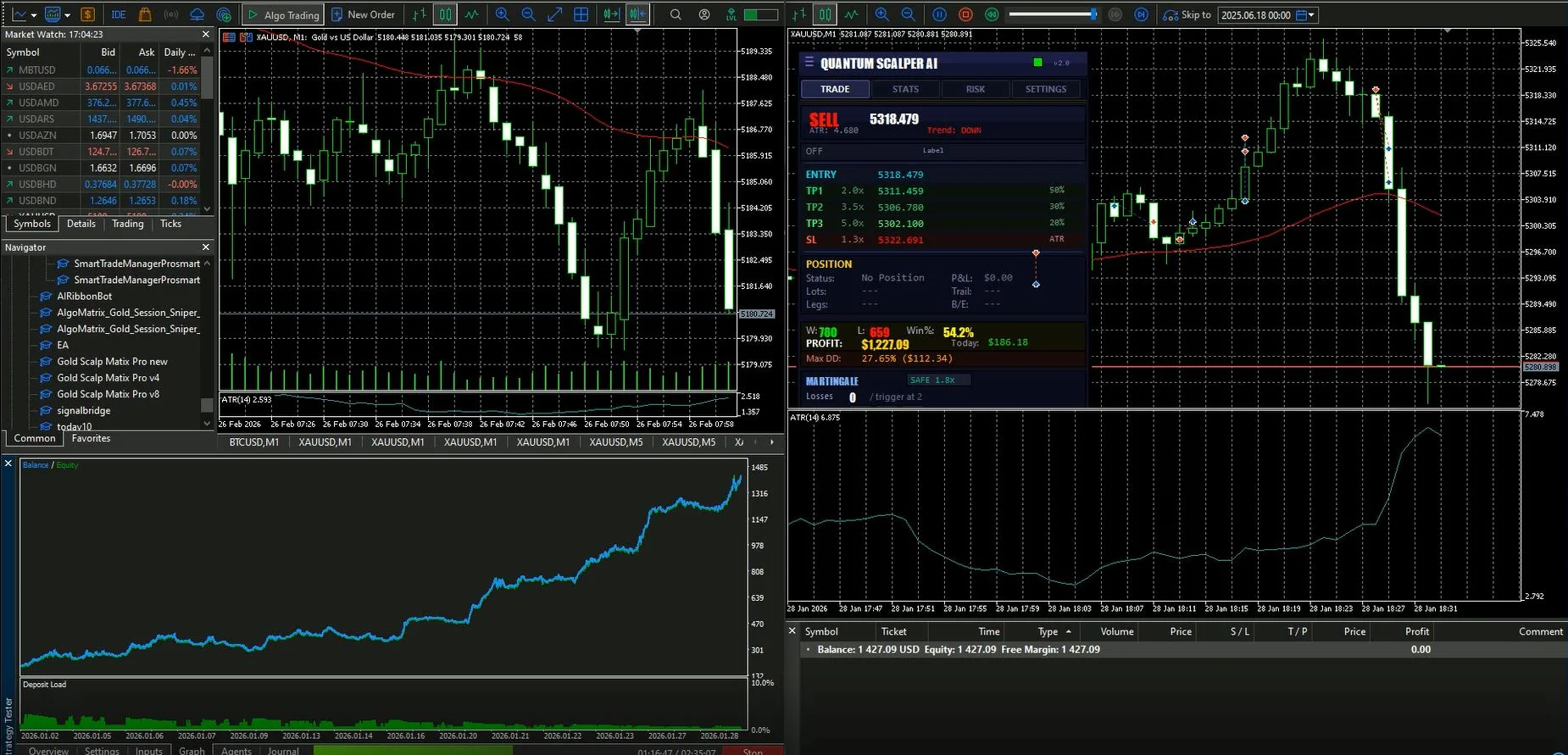
Every EA I build gets a proper on-chart display panel. Gold Quantum Scalper AI has a 4-tab panel that shows:
- Trading tab - current signal direction, ATR value, spread, active trade legs with their entry/SL/TP, P&L for each leg.
- Stats tab - total trades, wins, losses, win rate, profit factor, average win vs average loss, max drawdown, consecutive wins and losses.
- Risk tab - current recovery level, daily P&L, equity curve status, win-rate adaptive lot tier, market condition detection (normal/volatile/trending/ranging).
- Settings tab - runtime view of all active parameters including any auto-adapted values, so you can see in real time how the EA has adjusted itself.
The panel is draggable and fully color-customizable. I added the accent color as gold by default because, well, it's a gold scalper - might as well look the part.
Weekend Guard and Session Control
Gold traders know that holding positions over the weekend is risky. Gaps on Monday open can blow through your stop loss without it being triggered at the actual level. Gold Quantum Scalper AI includes a weekend guard that automatically closes all positions before Friday close (default: 20:00 UTC) and pauses trading until Monday morning.
The session filter further restricts trading to specific UTC hours. If you only want the EA to trade during London and New York overlap (the highest-volume window for gold), you can set it to trade only from 12:00 to 20:00 UTC. Outside those hours, the EA monitors but doesn't enter new trades.
Who Is This For?
Let me be honest about the target audience. Gold Quantum Scalper AI is not for beginners who want to press one button and make money. It has a lot of parameters - deliberately so, because experienced traders want control over every aspect of the robot's behavior.
This EA is for:
- Gold scalpers who trade XAUUSD on M5-M15 and want to automate their strategy while keeping sophisticated risk management.
- Systematic traders who appreciate adaptive systems that respond to changing market conditions rather than using static parameters.
- MT5 users who want full control over lot sizing, SL/TP modes, trailing behavior, and recovery logic - not a black box that makes decisions you can't understand.
- Traders who backtest - every parameter is optimizable in the MT5 Strategy Tester, so you can find the combination that works best for your broker and account size.
What I Learned Building This
Building Gold Quantum Scalper AI took significantly longer than any of my indicators. The auto-adapt engine alone went through several iterations - the first version adapted too aggressively and the parameters would oscillate wildly. The anti-oscillation mechanism and the ±30% cap were born from those failures.
The win-rate adaptive lot sizing was also tricky. The initial implementation used the lifetime win rate, which barely changes after 50+ trades. Switching to a rolling window (last 20 trades) made the system much more responsive to the EA's current performance state.
The biggest lesson? An adaptive system is only as good as its safety limits. Without the daily loss cap, the equity stop, the max recovery levels, and the anti-oscillation filter, the adaptation engine could theoretically optimize itself into a corner. Every "smart" feature needs a "failsafe" feature right next to it.
That's the engineering philosophy behind the entire EA: give the system intelligence, but always keep a human-defined boundary around what it's allowed to do. The EA adapts within limits. It doesn't go rogue.
If you trade gold and you've been looking for an EA that does more than blindly execute the same parameters day after day, give Gold Quantum Scalper AI a try. Run it in the Strategy Tester first - that's what it's there for. Optimize the parameters for your broker, your account size, your risk tolerance. And then let the adaptation engine do its job.
Disclaimer: This article describes the features and logic of a trading Expert Advisor and is not financial advice. Automated trading involves significant risk, including the risk of total capital loss. Past backtest results do not guarantee future performance. Always test on a demo account before deploying on live funds.