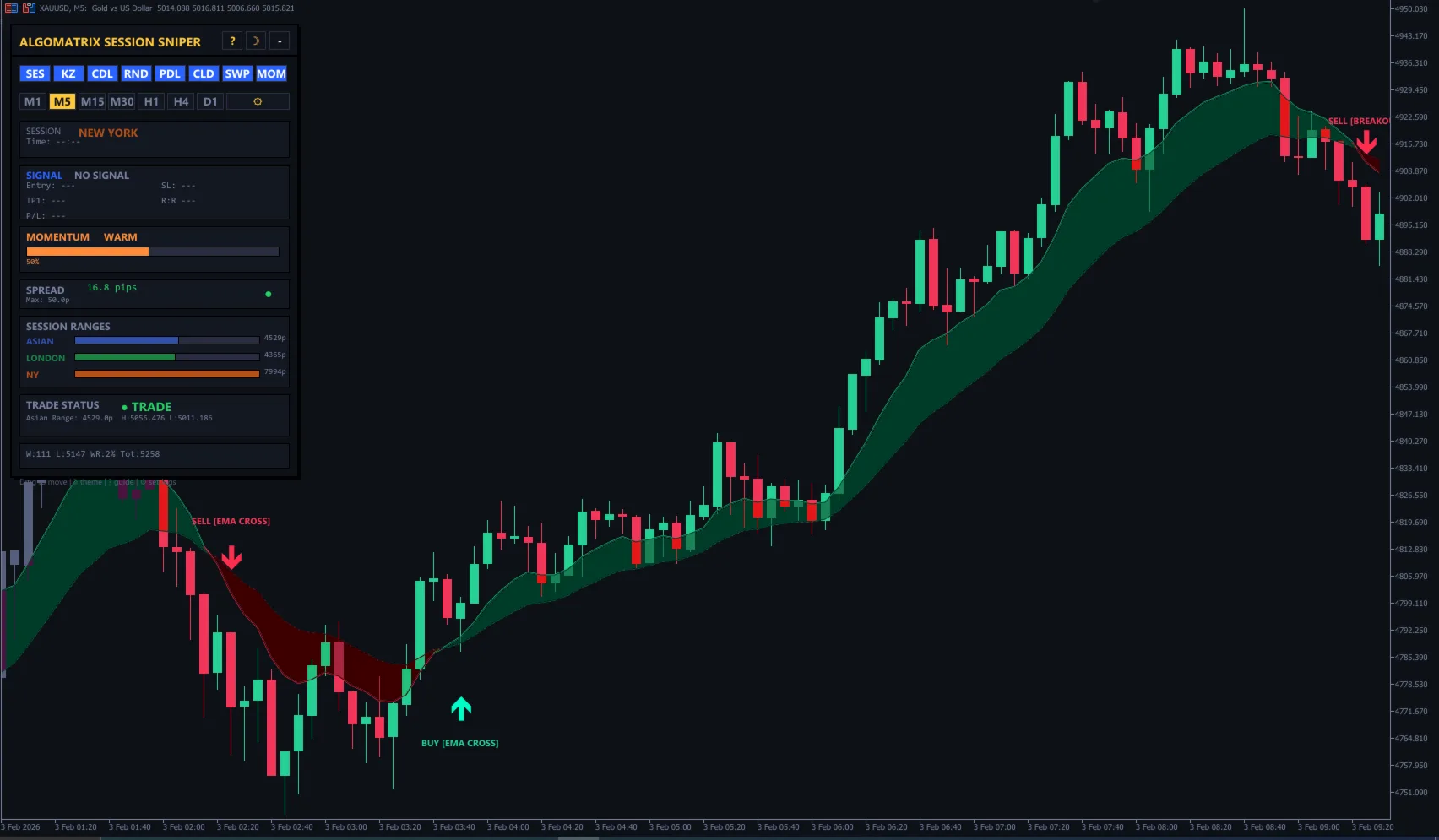
When I first started trading gold, I treated it like any other pair. I'd sit down whenever I had free time - sometimes at 6 AM, sometimes at midnight - and look for setups. Some days I'd catch beautiful moves. Other days, I'd sit there for hours watching price wiggle sideways, take a trade out of boredom, and lose money.
It took me an embarrassingly long time to realize that gold has a rhythm. It doesn't move randomly throughout the day. It has specific windows where it actually moves and specific hours where it just chops around doing nothing useful.
Once I started respecting those windows, my win rate went up and my frustration went down. Here's what I learned.
Gold Is Not a 24-Hour Market (Practically Speaking)
Yes, technically XAUUSD trades nearly 24 hours on weekdays. But "trading" and "moving" are very different things. For about 8-10 hours of each day, gold barely moves. Spreads widen, volume dries up, and any signal your indicator gives you is likely to result in a choppy, directionless trade.
The forex market runs in three major sessions: Asian (Tokyo), European (London), and American (New York). Each one has a different personality when it comes to gold. Let me break them down based on what I've actually experienced - not textbook theory.
Session 1: Asian Session (00:00 - 08:00 GMT)
What happens:
Honestly? Not much. Gold during the Asian session is typically quiet. It tends to drift sideways or make small, tentative moves that often get completely reversed once London opens. The range is tight - sometimes only 50-80 pips for the entire session.
Why it's quiet:
Gold is primarily priced in US dollars. The major liquidity providers for gold are in London and New York. During Asian hours, there's less institutional participation. The market is essentially in standby mode, waiting for European traders to wake up.
Do I trade it?
Almost never. The few times I've tried to scalp gold during Asian session, I've been chopped up by fake breakouts and random wicks. The risk-reward simply isn't there. The moves are too small to cover the spread plus generate a meaningful profit.
The one exception: if there's major news from China (like a surprise rate decision or economic data release), gold can spike during Asian hours. But these are event-driven trades, not my regular scalping setup.
What I actually do during Asian hours:
I identify the Asian session range. The high and low of the Asian session often act as the first levels that London tests, breaks, or bounces off. So even though I'm not trading it, I'm using it as context for my London session trades.
Session 2: London Session (08:00 - 16:00 GMT)
What happens:
This is where gold wakes up. The London session consistently produces the biggest moves in XAUUSD. European institutional traders enter the market, liquidity surges, and directional trends often begin here.
A typical London session pattern on gold looks like this:
- 08:00-08:30: Initial probing. Price often tests the Asian session high or low.
- 08:30-09:30: The first real directional move. This is frequently a stop hunt - price breaks above the Asian high (or below the Asian low) to trigger stops, then reverses sharply.
- 09:30-12:00: The main trend move of the day. Once the initial fake-out is done, gold tends to pick a direction and run. This is my primary scalping window.
- 12:00-13:00: Lunch lull. Volume drops as European traders take lunch. Price often consolidates or slightly retraces.
Do I trade it?
This is my bread and butter. About 70% of my trades happen between 09:00 and 12:00 GMT. The moves are directional, the ribbon expands cleanly, and the follow-through is reliable enough for scalping.
My favorite London setup:
After the Asian range gets broken (usually between 08:30 and 09:30), I wait for the EMA ribbon to expand in the breakout direction. Then I wait for a pullback into the ribbon and enter on rejection. This setup has the highest win rate of anything I trade.
Session 3: New York Session (13:00 - 21:00 GMT)
What happens:
The New York session brings a second wave of liquidity. American institutional traders join, and if there's US economic data (NFP, CPI, FOMC), gold can make its biggest move of the day here.
The critical window is the London-New York overlap (13:00-16:00 GMT). This is when both European and American markets are active simultaneously, creating peak liquidity and often peak volatility.
Do I trade it?
Selectively. The London-New York overlap (13:00-15:00 GMT) can produce excellent continuation trades if gold has established a clear direction during London. But it can also be chaotic - especially around US data releases.
My rule: if the London session established a clear trend (expanded ribbon, clean structure), I'll trade the New York continuation. If London was choppy or indecisive, I skip New York entirely. Two messy sessions don't make a clean one.
After 16:00 GMT, when London closes, I stop trading. Gold after London close is like gold during Asian session - directionless and spread-heavy. It's not worth the risk.
The Session Boundaries That Actually Matter
Through experience, I've found that certain session transitions are more important than the sessions themselves:
Asian -> London transition (07:30-08:30 GMT): This is where the Asian range gets established and London starts to probe it. I'm not trading yet, but I'm marking levels.
London open first hour (08:00-09:00 GMT): The stop hunt window. Watch for fake breakouts of Asian highs/lows. Don't chase the first move - it's often a trap.
London-New York overlap start (13:00-13:30 GMT): Another potential reversal or acceleration point. US traders enter and often disagree with the London move initially, causing a retracement before the real move continues.
How I Visualize Sessions on My Chart
I built Gold Session Sniper Pro specifically because I was tired of manually calculating session times. It draws colored boxes on the chart for each session - so I can instantly see where Asian range is, where London structure formed, and where New York volume kicked in.
Having session zones visible on the chart changes how you read price. Instead of just seeing candles, you see context. "Oh, this breakout happened at London open - let me wait for the potential fake-out before entering." That kind of thinking only happens when you can see session boundaries.
A Typical Day in My Trading Routine
Here's what my actual day looks like, session by session:
07:30 GMT: Open charts. Mark the Asian session high and low. Check daily and H4 trend direction. Note any upcoming news events.
08:00-08:30 GMT: Watch London open price action. Note whether price is attacking the Asian high or low first. Don't trade yet.
08:30-09:00 GMT: Look for the stop hunt / fake-out move. If it happens, prepare for a reversal setup.
09:00-12:00 GMT: Active trading window. Look for EMA ribbon expansion setups aligned with the London direction. Take 1-3 trades maximum.
12:00-13:00 GMT: Break. Close any open positions or tighten stops. Don't open new trades during the lunch lull.
13:00-15:00 GMT: London-New York overlap. If London had a clear trend, look for continuation trades. If not, stay out.
15:00+ GMT: Done for the day. Review trades, journal entries, and shut down MT5.
The Days I Don't Trade At All
Not every day has clean session dynamics. Some days I sit down, check the charts, and close my laptop within 30 minutes. This happens when:
- Monday Asian session is extended: Markets are finding their footing after the weekend. Monday London can be messy.
- Major news day (NFP, FOMC): Gold goes into waiting mode before the announcement, then spikes violently when it hits. I don't trade pre-news because signals are unreliable, and I don't trade the spike because the spread widens to absurd levels.
- Friday after 14:00 GMT: Institutions are closing positions for the weekend. Price action becomes erratic and unreliable.
- Holiday sessions: US or UK bank holidays mean reduced liquidity. Gold barely moves, and when it does, the moves are choppy.
Why Session Awareness Changed My Trading
Before I understood sessions, I was essentially trading blind to context. An EMA ribbon expansion at 3 AM GMT means something completely different than the same expansion at 9 AM GMT. The first one is likely noise in thin liquidity. The second one is likely the beginning of a real directional move with institutional backing.
Session awareness doesn't give you signals. It gives you context. And context tells you which signals to trust and which ones to ignore.
If you're scalping gold and you haven't incorporated session timing into your analysis, start with the basics: only trade between 09:00 and 15:00 GMT. Just that one change - cutting out the noise hours - will probably improve your results more than any new indicator.
And if you want session zones drawn automatically on your chart with interactive highlighting, my Gold Session Sniper Pro handles all of it. It also marks the Asian session range specifically - the levels I use as my first reference points every morning.
Disclaimer: This article reflects my personal trading routine and observations. Session dynamics can vary based on market conditions, news events, and broker time zones. Trading involves significant risk. This is not financial advice.