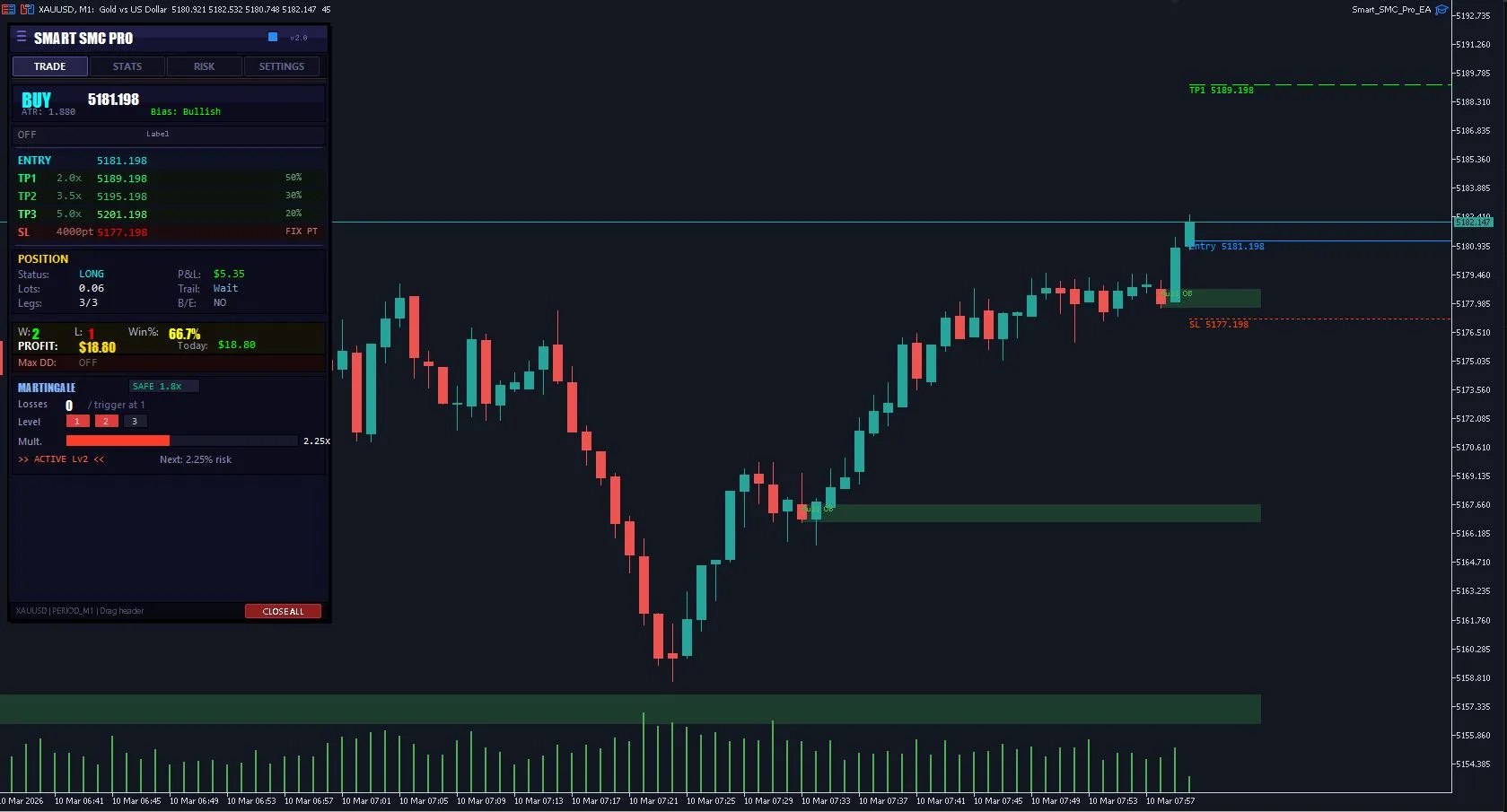
Smart Money Concepts changed how an entire generation of traders reads charts. Instead of lagging indicators and oscillator crossovers, SMC traders look at the structural footprints left by institutional money — fair value gaps, order blocks, breaks of structure, and liquidity sweeps. The problem? Executing this analysis manually is exhausting. You need to constantly track swing highs and lows, identify fresh versus mitigated FVGs, monitor for BOS in real-time, and then execute with precision timing while managing risk.
That's why I built Smart SMC Pro Gold EA. It automates the entire Smart Money Concepts workflow specifically for XAUUSD — detecting break of structure for directional bias, identifying fresh fair value gaps and order blocks for entry zones, recognizing liquidity sweeps for timing, and managing each trade with ATR-adaptive stop losses and take profits.
This article explains every component of the SMC engine, how the concepts translate from manual chart reading to algorithmic detection, and why gold is one of the best instruments for SMC-based automated trading.
Fair Value Gap Explained — The Core Entry Concept
If you're new to Smart Money Concepts, a fair value gap is the single most important pattern to understand. It reveals where institutional traders moved price so aggressively that a gap formed in the price delivery — an area where buying and selling didn't occur in a balanced way.
How a Fair Value Gap Forms
Imagine three consecutive candles on a gold chart. The first candle is a small bearish candle. The second candle is a massive bullish candle — so large that its body extends well beyond the first candle's range. The third candle opens at or near the top of the second candle and continues upward.
Now look at the gap between the first candle's high and the third candle's low. There's empty space — price never traded at those levels because the second candle blew through them so fast. That empty space is the fair value gap. It represents unfilled institutional orders and inefficient price delivery.
Why does this matter? Because price has a strong tendency to return to these gaps and "fill" them before continuing in the original direction. Smart money entered aggressively, creating the gap, and when price returns to that zone, those same institutions often add to their positions at better prices.
How the EA Detects FVGs Algorithmically
Smart SMC Pro Gold EA scans every three-candle sequence looking for the FVG pattern. For a bullish FVG, it compares Candle[1].High with Candle[3].Low — if there's a gap (Candle[3].Low > Candle[1].High), a bullish FVG is registered. For bearish FVGs, it checks if Candle[3].High < Candle[1].Low.
But not every FVG is worth trading. Small gaps caused by normal price fluctuation are noise, not institutional activity. The EA applies an ATR-based minimum size filter — only gaps that exceed a threshold relative to current ATR are registered as valid. On gold, this typically means the gap needs to be at least 5-8 points during normal volatility to qualify.
Each valid FVG is tracked with three properties: its price range, whether it's fresh or mitigated, and the direction (bullish or bearish). When price returns to a fresh FVG zone, the EA considers it as a potential entry area.
Break of Structure — The Directional Filter
FVGs appear in both directions during any given period. Without a directional filter, you'd be taking long and short entries simultaneously, which makes no sense. Break of structure provides that filter.
How BOS Works
Market structure is the sequence of swing highs and swing lows that price creates. In an uptrend, you see higher highs (HH) and higher lows (HL). In a downtrend, lower highs (LH) and lower lows (LL).
A break of structure occurs when this sequence changes. If price has been making lower highs and lower lows, and then it sweeps above the most recent lower high, that's a bullish BOS — structure has shifted from bearish to bullish. The reverse creates a bearish BOS.
Smart SMC Pro Gold EA tracks swing points using a configurable lookback (default: 20 bars) and monitors for BOS events in real-time. When a bullish BOS occurs, the EA switches to "long bias" mode — it will only enter trades from bullish FVGs and bullish order blocks. Bearish BOS switches to "short bias" mode.
BOS Confirmation vs. Anticipation
The EA requires a candle close beyond the swing point, not just a wick. This is the "confirmation" approach — slower but more reliable. Wick-based BOS detection (anticipation) catches turns earlier but generates more false signals, especially on gold where wicks frequently exceed swing levels during volatile sessions without actually changing the structure.
You can adjust the swing lookback period to control sensitivity. A 20-bar lookback captures medium-term structure shifts (ideal for M15-H1). Reducing it to 10 bars makes BOS detection more responsive but also more prone to false signals from minor swings.
Order Block Trading — Where Institutions Left Their Footprint
If fair value gaps show you where institutional momentum created inefficiency, order blocks show you where institutions placed their original orders. The two concepts work together: BOS gives direction, order blocks and FVGs give entry zones.
Identifying Order Blocks
An order block is the last opposing candle before an impulsive move. Before a strong bullish rally, the last bearish candle (or group of candles) represents a zone where institutional buy orders were placed at lower prices. Before a strong selloff, the last bullish candle represents institutional sell orders.
The EA identifies order blocks by finding candles that precede a move resulting in a break of structure. This ensures the order block is associated with a genuine structural shift rather than a random swing. The zone is defined from the order block candle's open to its extreme (low for bullish OB, high for bearish OB).
Order Block vs. Fair Value Gap — When to Use Each
In practice, order blocks and FVGs often occur near each other, and sometimes overlap. The EA uses both as valid entry zones but applies different confidence levels. A "confluence zone" — where an FVG and an order block overlap — is the highest probability entry. A standalone FVG or standalone order block is secondary.
On gold specifically, confluence zones appear frequently during the London session as institutional orders from overnight accumulation get filled. The EA marks these confluence zones with a higher priority score, and if you enable the "confluence only" mode, it will skip entries that don't have both an FVG and OB present.
Liquidity Sweep Detection
This is the component that most SMC indicators miss entirely, and it's arguably the most important timing tool in the entire framework.
What Liquidity Sweeps Look Like on Gold
Retail traders place stop losses at obvious levels — below swing lows, above swing highs, at round numbers like $3,000, $3,050, $3,100. These clusters of stop orders represent liquidity. Institutional traders know where these stops are (the order book isn't secret on most exchanges) and deliberately push price through these levels to trigger the stops, absorbing the liquidity for their own large orders.
On gold, liquidity sweeps happen constantly. Price pushes 3-5 points below a swing low, triggers everyone's stop losses, and then immediately reverses. The wick below (or above) the swing level is the sweep. The reversal candle is your entry signal.
How the EA Detects and Trades Sweeps
The EA tracks all significant swing highs and lows within the lookback period. When price exceeds a swing level by a wick but the candle body closes back within the range, the EA registers a liquidity sweep. If this sweep occurs near a fresh FVG or order block, and BOS direction aligns, it's a very high-probability entry.
The liquidity sweep acts as the timing mechanism in what I call the "SMC stack": BOS provides direction → FVG/OB provides the zone → liquidity sweep provides the timing. When all three align, the EA enters.
The Complete Trade Execution Flow
Let me walk through exactly how the EA processes a typical gold trade from detection to exit.
Step 1: Structure Assessment
The EA continuously monitors swing highs and lows on the configured timeframe (default M15). It maintains a running record of the latest BOS direction. Currently, BOS is bullish — price broke above the last lower high, confirming a shift to higher highs.
Step 2: Zone Identification
With bullish BOS active, the EA scans for bullish entry zones: bullish FVGs (gap between candle 1 high and candle 3 low below price) and bullish order blocks (last bearish candle before the BOS move). It identifies a fresh bullish FVG between $3,042 and $3,048 from three bars ago, and a bullish order block zone from $3,038 to $3,045 from the impulsive move that caused BOS.
Step 3: Entry Trigger
Price retraces toward the identified zones. As it enters the $3,042-$3,048 FVG range, the EA arms itself. Then price dips to $3,039, briefly sweeping below the order block's lower boundary at $3,038, triggering stop losses of traders who went long at $3,045. The candle's body closes back at $3,044 — inside the order block zone. Liquidity sweep detected + FVG zone + OB zone + bullish BOS = full confluence. The EA enters long at $3,044.
Step 4: Trade Management
Stop loss is placed below the liquidity sweep low at $3,036 (sweep low minus ATR buffer). TP1 is set at the most recent swing high ($3,062), TP2 at 2× the SL distance ($3,060), and TP3 at the next key structural level. The EA moves the SL to breakeven once price reaches the 50% level between entry and TP1.
Step 5: Exit
If price hits TP1, partial close executes (configurable, default 50% of position). The remainder trails toward TP2/TP3 with a trailing stop that follows structure — moving to each new higher low rather than a fixed pip distance. If a bearish BOS occurs before TP is reached, the EA closes the entire trade immediately as the structural basis for the trade has been invalidated.
Why Gold Is Ideal for SMC Automated Trading
I've tested this EA on forex majors, indices, and crypto. Gold outperforms all of them for SMC-based strategies. Here's why.
Clear Institutional Footprints
Gold is traded by central banks, sovereign wealth funds, and large hedge funds. These entities move size that creates very clear FVGs and order blocks. Their activity is especially visible during London open when overnight institutional orders from Asia are executed, creating distinct impulsive moves followed by clean retracements to FVG zones.
Predictable Session Behavior
Gold's session-based volatility pattern is one of the most consistent in all of financial markets. The Asian accumulation → London impulse → New York continuation cycle repeats with remarkable regularity. An EA can exploit this pattern mechanically without needing to interpret "market mood."
Frequent Liquidity Sweeps
Because retail gold traders overwhelmingly use round-number stops and swing-point stops, the liquidity pools on XAUUSD are dense and predictable. Institutions sweep these levels like clockwork, creating multiple sweep-based entry opportunities per session.
Strong Trending Nature
Gold trends for extended periods, especially during rate-cycle phases and geopolitical uncertainty. During trending markets, BOS direction stays consistent for days or weeks, allowing the EA to maintain a clear directional bias without frequent flip-flopping.
Settings Guide for Different Trading Styles
Conservative Approach
Enable "confluence only" mode — the EA only enters when an FVG, order block, and liquidity sweep all align. This reduces trade frequency to 3-5 trades per week but maximizes win rate (typically 65-72% in testing). Use 1% risk per trade, M15 timeframe, and London+NY sessions only.
Moderate Approach (Default)
The EA enters on FVG or OB zones with BOS confirmation. Liquidity sweep is a bonus but not required. Trade frequency increases to 8-12 trades per week with a win rate around 58-63%. Use 1-1.5% risk per trade, M15 timeframe, London+NY sessions.
Aggressive Approach
Enable M5 timeframe, lower the BOS swing lookback to 10 bars, and extend the session window to include late New York. Trade frequency jumps to 15-25 per week but win rate drops to 52-55%. Only suitable for accounts that can handle the higher trade count and associated drawdown spikes. Use 0.5-1% risk per trade to compensate.
How Smart SMC Pro Differs from Manual SMC Trading
Manual SMC traders often argue that algorithmic SMC can't capture the "discretionary edge" — the ability to read context, sense market mood, and make judgment calls that no algorithm can match. They're partially right. Here's where the EA is better, and where it's not.
Where the EA Wins
Consistency. A manual trader might identify five perfect FVG setups in a day but only take three because fatigue, distraction, or emotional hesitation causes them to miss two. The EA takes all five without exception. Over months, this consistency matters enormously.
Speed. The EA identifies FVGs, OBs, and liquidity sweeps within milliseconds of each new bar closing. A manual trader scanning multiple timeframes might need 30-60 seconds per analysis cycle. On gold during volatile sessions, those seconds can mean missing the optimal entry by 5-10 points.
Risk discipline. The EA never moves a stop loss further away. Never takes a "revenge trade." Never increases lot size to recover a loss. The mechanical risk management protects capital during drawdowns when human psychology would be doing the opposite.
Where Manual Trading Wins
Context awareness. A manual trader sees the broader picture — upcoming FOMC, ongoing geopolitical events, unusual market behavior. The EA doesn't know that today is an FOMC day and that all setups for the next 2 hours should be skipped. You need to handle this by manually pausing the EA during major events.
Complex structural reads. Nested BOS patterns, higher-timeframe premium/discount zones, and order flow from multiple sessions are hard to encode algorithmically. The EA uses a simplified but effective version of SMC structure. A skilled manual trader might decode more nuanced patterns.
Realistic Performance Expectations
Every EA article should include this section, and most skip it because the honest numbers aren't as impressive as marketing fantasies.
In backtesting across 2023-2025 XAUUSD data on M15 with default settings, Smart SMC Pro Gold EA shows a profit factor of 1.5-1.8, win rate of 60-65%, maximum drawdown of 10-15%, and average trade duration of 1-4 hours. Monthly returns range from -4% to +10%, with approximately 9 positive months out of 12.
Forward testing degradation of 0.1-0.3 profit factor points is expected. Live performance also depends heavily on your broker's execution quality and gold spread during your session windows.
The EA doesn't produce extraordinary monthly returns. What it does produce is a consistent, positive expectancy based on structural market logic that has worked for years and has a theoretical basis for continuing to work — institutions will always leave footprints in price.
Getting Started
Download Smart SMC Pro Gold EA from MQL5 Market. Attach it to a XAUUSD M15 chart. The EA immediately begins mapping swing structure, identifying FVGs and order blocks, and displaying its current BOS direction and active zones on the chart.
Run on demo for at least 3 weeks and 40+ trades before going live. Compare the live entries with your own manual SMC analysis — if the EA is identifying the same structures you would, you'll build confidence in the system. If it's taking trades you wouldn't, study its logic and understand why. Often, the EA catches valid setups that a manual trader would have missed due to not watching the chart at that exact moment.
Start with 1% risk and the conservative "confluence only" mode. Increase complexity only after you've validated performance on your specific broker.
Disclaimer: This article describes an automated trading system for educational purposes. Trading involves significant risk of loss. Past performance and backtesting results do not guarantee future results. Smart Money Concepts do not provide certainty about institutional activity. Always use proper risk management and only trade with capital you can afford to lose.