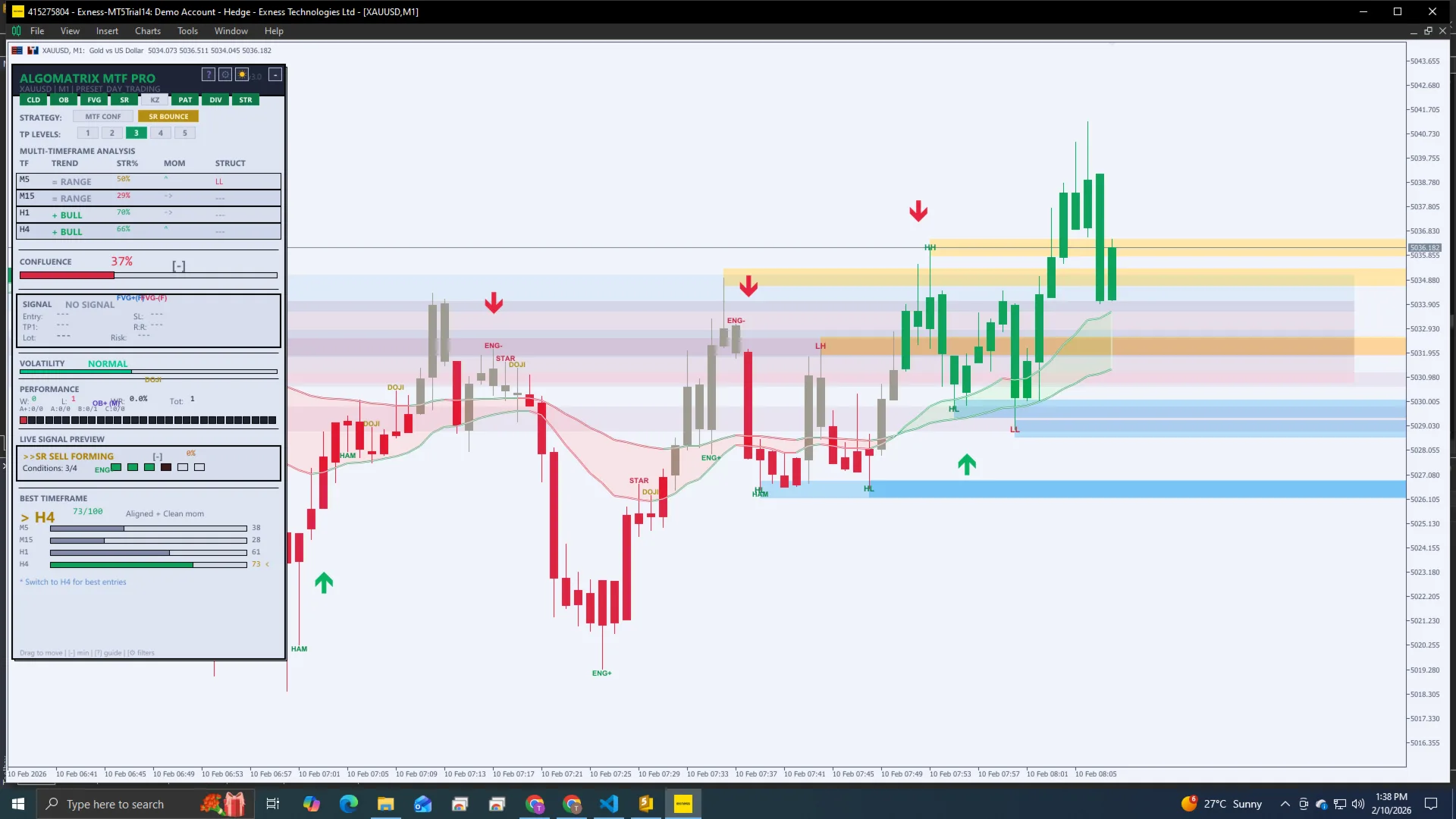
The single biggest improvement to my trading didn't come from finding a better indicator, a faster timeframe, or a more volatile pair. It came from learning to say no. Specifically, learning to grade every signal before I take it - and only trading the A+ setups while sitting out the B and C grades.
This article is about building a signal grading system: how to combine multiple indicators into a single confidence score, the specific criteria I use, and why taking fewer but better trades is mathematically superior.
The Overtrading Trap
When I started trading, I took every signal. RSI oversold? Buy. MACD crossover? Buy again. EMA cross? Triple buy. I was making 15-20 trades per session, and my equity curve looked like a seismograph during an earthquake.
The problem wasn't the individual indicators - they were fine. The problem was that each indicator, in isolation, has a mediocre win rate. RSI oversold correctly predicts a bounce about 50-55% of the time. MACD crossover is similar. But when both RSI and MACD AND EMA alignment all agree simultaneously, the win rate jumps to 65-70%. The confluence is where the edge lives.
After switching to confluence-only trading, my trade count dropped from 15+ per session to 3-5. My win rate went from 48% to 62%. My profit increased because I stopped losing money on C-grade setups that diluted my A-grade wins.
My Signal Grading Framework
I grade every signal on a scale of A+ to C. Here's the framework:
A+ Signal (take immediately, full size):
- Trend alignment across multiple timeframes (H1 trend matches M5/M15 signal direction)
- At least 3 indicators confirming the same direction
- Active session (London or NY kill zone)
- Clean chart structure (not in the middle of a range or at a known resistance without catalyst)
- Acceptable spread (below 25 pips for gold)
B Signal (consider, reduced size):
- 2 indicators confirming
- Trend is present but not strongly aligned across timeframes
- Active session but outside kill zone
C Signal (skip):
- Only 1 indicator signaling
- Counter-trend on higher timeframe
- Asian session or low-liquidity period
- Wide spread or choppy price action
The Indicators I Combine
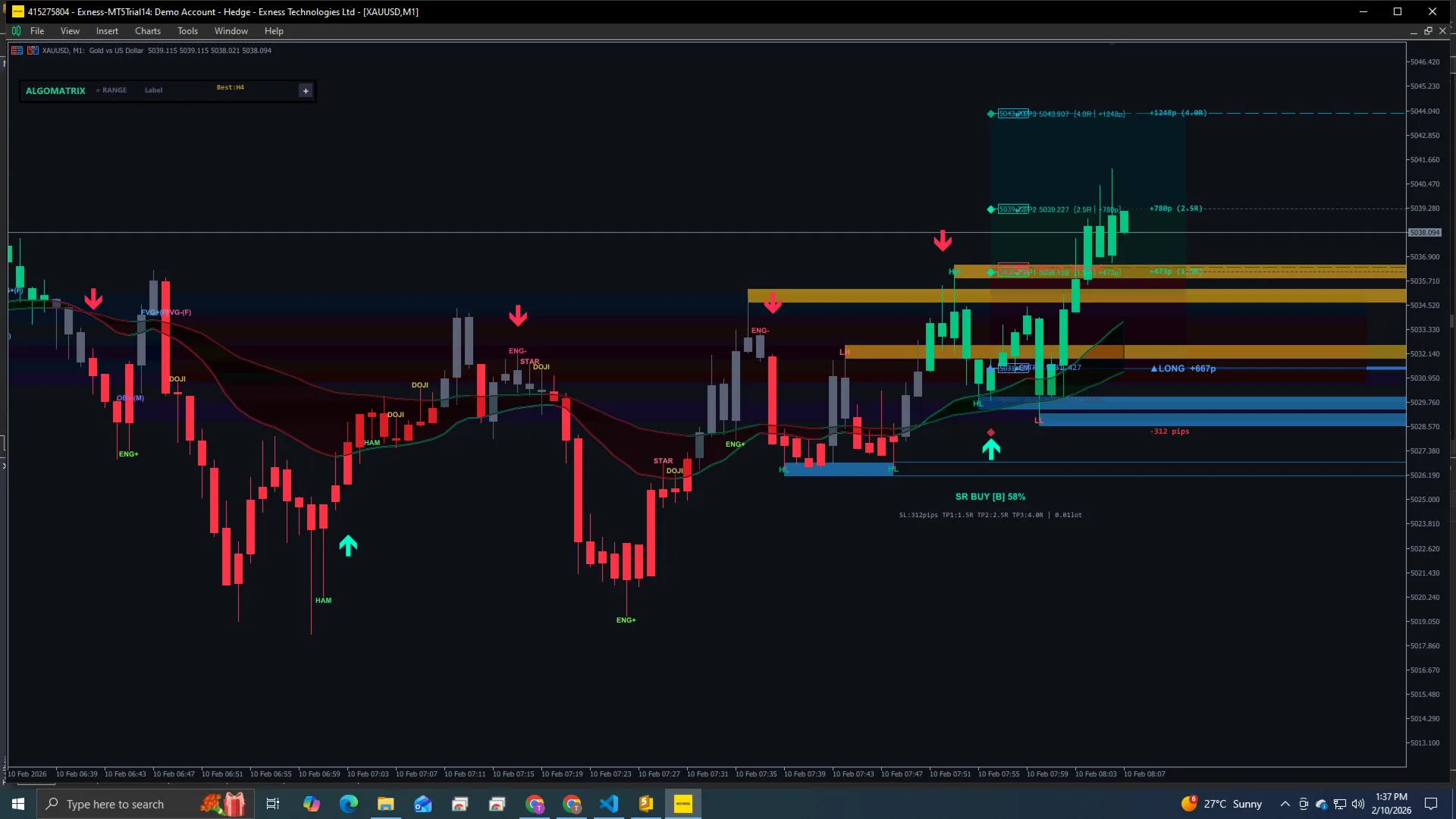
My confluence engine in Buy Sell Signal Pro combines five categories of confirmation:
1. Trend (EMA alignment)
Fast EMA above slow EMA = bullish trend. The wider the gap, the stronger. This is the foundational filter - if the trend says down, I'm not taking buy signals regardless of what oscillators say.
2. Momentum (RSI)
Not just overbought/oversold - I look at RSI momentum direction. RSI rising from 40 toward 60 confirms bullish momentum without being overbought. RSI already at 80 with a signal means the move might be exhausted.
3. Signal strength (MACD)
MACD histogram growing in the signal direction means momentum is accelerating. Shrinking histogram means momentum is dying - even if the signal line hasn't crossed yet. I use the histogram as an early warning system.
4. Cycle position (Stochastic)
Stochastic tells me where we are in the short-term cycle. A buy signal with stochastic coming OUT of oversold is optimal - it has room to run. A buy signal with stochastic already at 90 is late - the cycle is about to turn.
5. Volatility context (ATR)
ATR above average means the market is active and directional signals are more likely to follow through. ATR below average means the market is quiet and signals are more likely to produce small, range-bound moves. I increase my TP targets during high-ATR periods and reduce them during low-ATR.
How the Scoring Works
Each indicator category contributes to a total score:
- Trend confirmation: +2 points (highest weight - no trend, no trade)
- RSI confirmation: +1.5 points
- MACD confirmation: +1.5 points
- Stochastic position: +1 point
- ATR context: +1 point
Maximum possible score: 7 points. My grading:
- A+ (6-7 points): 4-5 indicators confirming. Strongest signal. Full size.
- A (5 points): 3-4 confirming. Still strong. Standard size.
- B (3-4 points): 2-3 confirming with partial conflicts. Half size or skip.
- C (0-2 points): Weak agreement or conflicting signals. Always skip.
The indicator shows this score on every signal arrow, so I don't have to manually calculate. A quick glance tells me whether the signal is worth taking.
Multi-Timeframe Confluence
Single-timeframe confluence is good. Multi-timeframe confluence is better.
My approach: I analyze on H1 for the trend direction, then look for entries on M15 or M5. An A+ setup requires that the H1 chart ALSO grades as bullish (for a buy signal) or bearish (for a sell signal).
Here's a specific example: M15 gives a buy signal with 5/7 score. MACD is growing, RSI is rising, EMAs are bullish, stochastic is coming out of oversold. But H1 shows a bearish MACD, RSI falling, and EMAs recently crossed bearish. I downgrade from A+ to B and either skip or enter half size.
The reverse: M15 buy signal with 4/7 (A grade), and H1 is also bullish with all indicators aligned. I upgrade this to A+ because the higher timeframe support makes the M15 signal much more reliable.
The Math: Why Selectivity Wins
Let me show you the numbers that convinced me:
Scenario 1 - Take every signal (15 trades/session):
- Win rate: 48%
- Average win: $12
- Average loss: $10
- Expected value per trade: (0.48 x $12) - (0.52 x $10) = $5.76 - $5.20 = +$0.56
- Expected per session (15 trades): +$8.40
Scenario 2 - Only A/A+ signals (4 trades/session):
- Win rate: 62%
- Average win: $15 (better entries lead to better R:R)
- Average loss: $10
- Expected value per trade: (0.62 x $15) - (0.38 x $10) = $9.30 - $3.80 = +$5.50
- Expected per session (4 trades): +$22.00
Scenario 2 generates 2.6x more profit with fewer trades, less commission, less stress, and more time to analyze each setup properly. This is why signal grading isn't just "nice to have" - it's the difference between marginal and profitable.
Building Signal Grades Into Your Routine
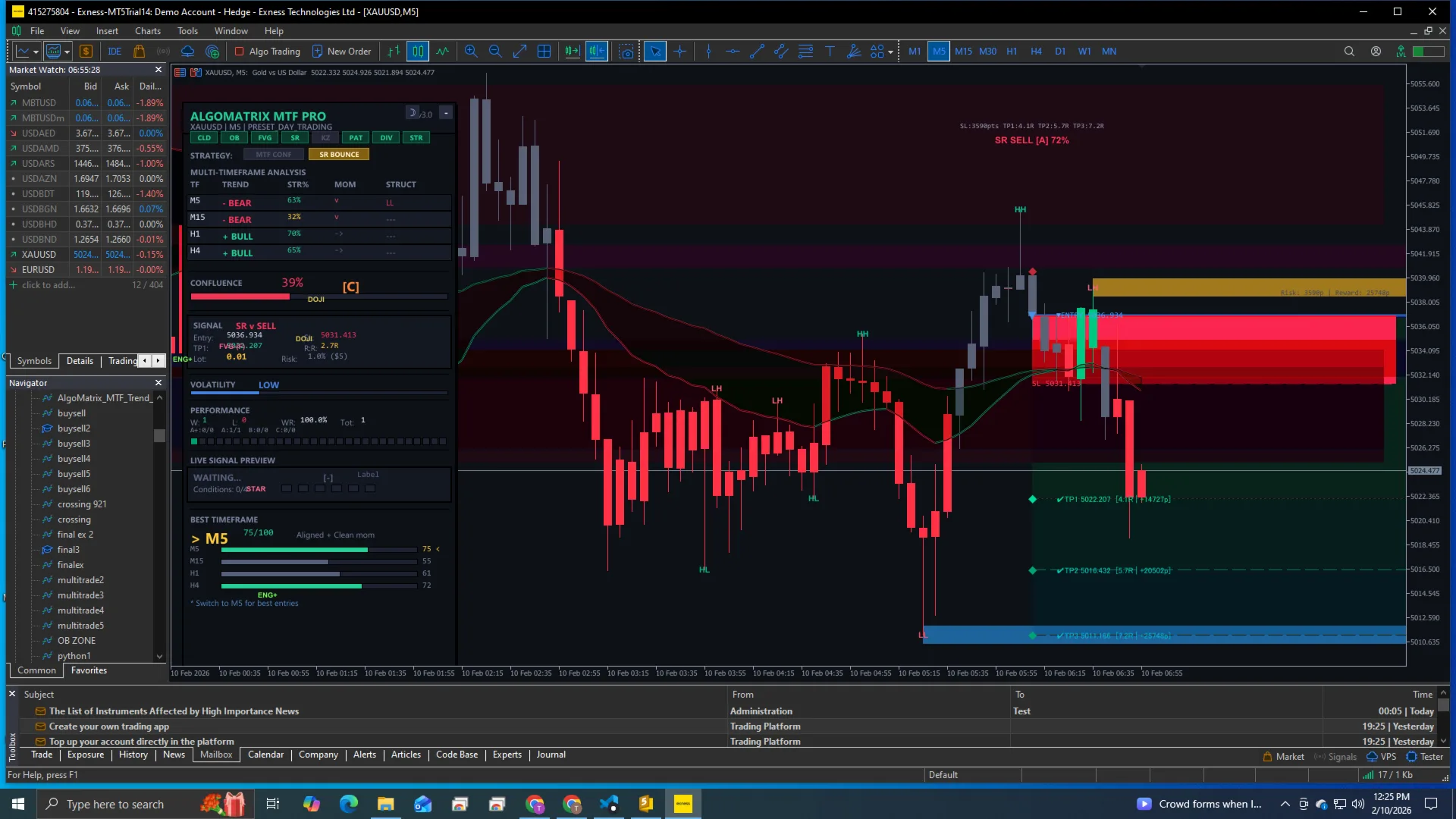
You don't need a fancy indicator to start grading signals. Here's how to do it manually:
- Before the session: Add your 3-5 favorite indicators to the chart. Mine are EMA crossover, RSI 14, MACD, and stochastic.
- When a signal appears: Count how many indicators agree. Write it on a sticky note if you need to.
- Grade it: All agree = A+. Most agree = A. Half agree = B. Minority agree = C.
- Enforce the rule: Only trade A and A+. No exceptions. This is the hard part - your brain will scream "but it looks good!" on B-grade setups. Ignore it.
After doing this manually for a few weeks, you'll internalize the process. You'll start seeing signal quality before you consciously check each indicator. That's the experience that develops - and it's worth far more than any single indicator.
For traders who want this automated, Buy Sell Signal Pro calculates the confluence score automatically and only plots arrows when the score exceeds your configured threshold. Combined with the Multi Scanner Pro for finding which pairs to focus on, you have a complete pre-trade analysis pipeline.
Real Trade Example: Scoring a Signal Step by Step
Let me walk through an actual signal I evaluated during a recent London session on XAUUSD M15:
The setup: Price pulled back to the EMA 21 zone during a bullish London push. A buy arrow appeared on the M15 candle close at $2,812.
Scoring each indicator:
- EMA Trend (+2): All EMAs in bullish order on M15. The 8 EMA was above 13, above 21, above 34. H1 also had bullish EMA alignment. Full 2 points.
- RSI (+1.5): RSI was at 54, rising from 42. Not overbought, good momentum direction. Full 1.5 points.
- MACD (+1.5): MACD histogram was positive and growing - each bar taller than the last. Signal line was above zero. Full 1.5 points.
- Stochastic (+0.5): Stochastic K was at 72. Not oversold (which would be ideal for a buy), but not at 90+ either. Partial - 0.5 out of 1.
- ATR (+1): ATR was 1.3x the 20-period average - above-average volatility during London session. Market was active. Full 1 point.
Total: 7 out of 7 - A+ signal.
I entered with full position size. TP1 hit within 25 minutes. TP2 hit 40 minutes later. The runner exited on trailing stop after capturing a $22/lot move. If I had taken this trade without checking stochastic and ATR, it still would have worked - but knowing ALL five categories agreed gave me the confidence to hold through a brief 3-candle pullback after entry instead of panicking out.
Now compare that to a B-grade signal from the same week: M15 buy arrow appeared, but RSI was already at 78 (near overbought), MACD histogram was flat (not growing), and stochastic was at 88. Score: 4.5/7 - a B signal. I skipped it. Price did move up 50 pips, then reversed 120 pips. The initial move would have hit TP1, but the reversal would have stopped out the remaining position at a loss. Net result would have been breakeven or slightly negative. By skipping, I preserved capital and mental energy for the next A+ setup.
Common Confluence Mistakes to Avoid
- Using too many indicators from the same category. Adding RSI, CCI, and Williams %R is not confluence - they're all momentum oscillators and will agree most of the time. Real confluence means combining different types: trend (EMA) + momentum (RSI) + cycle (Stochastic) + volatility (ATR). Each should measure something different.
- Changing your rules after a losing streak. You take three A+ trades in a row and they all lose. Your brain screams "the system is broken!" It's not - even a 65% win rate means 3 consecutive losses happen roughly 4% of the time. That's once every 25 trading sessions. Expect it. Don't abandon the grading system because of normal variance.
- Upgrading B signals to A because you're bored. The most dangerous time for a signal grader is a quiet session. You've been watching for two hours with no A+ signals. A B-grade arrow appears and you think "close enough." This is exactly when discipline matters most. B signals have B results.
- Ignoring the time of day. A 6/7 score at 2 AM on a Sunday evening is NOT the same as 6/7 during London kill zone. Session context isn't in the indicator score - you need to apply it as an additional filter. All my A+ rules include "active session" as a requirement.
- Not keeping a signal journal. How do you know your grading system works if you don't track it? For the first month, log EVERY signal you see - its grade, whether you took it, and the outcome. After 100 signals, analyze: what's the win rate for A+ vs A vs B? If A+ isn't meaningfully better than B, your scoring criteria need adjustment.
Adapting the Framework to Different Markets
While I developed this system for XAUUSD, the framework applies to any instrument with some weight adjustments:
- Major forex pairs (EURUSD, GBPUSD): These trend more smoothly than gold, so EMA weight can be even higher. ATR matters less because volatility is more consistent. I'd shift RSI weight up slightly.
- Cryptocurrency: Extreme volatility means ATR becomes the most important context. A signal during 3x average ATR on Bitcoin is very different from normal ATR. Also, there's no "session" filter since crypto trades 24/7 - replace it with volume analysis.
- Indices (NAS100, US30): Strong session dependence like gold. The scoring model transfers well, but stochastic is less useful on indices because trends can stay overbought/oversold for extended periods. Consider replacing stochastic with ADX for trend strength.
The principle stays constant: combine indicators that measure different things, weight them by importance, quantify the result, and only trade when the score exceeds your threshold. The specific indicators and weights are adjustable - the discipline of scoring is not.
Frequently Asked Questions
What is confluence in trading?
Confluence means multiple independent indicators or analytical methods agreeing on the same trade direction. Instead of relying on a single signal (e.g., RSI oversold), confluence trading requires 3-5 different indicator types - trend, momentum, oscillator, volatility - to all confirm the same setup before entering a trade. This filters out low-quality signals and significantly improves win rates.
How many indicators should I use for confluence?
Three to five indicators from different categories is the sweet spot. Using fewer than three doesn't provide enough filtering. Using more than five creates analysis paralysis - you'll rarely see all seven or eight indicators agree, which means you'll never trade. My system uses five: EMA (trend), RSI (momentum), MACD (signal strength), Stochastic (cycle position), and ATR (volatility context).
Does signal grading work on all timeframes?
Yes, but the optimal threshold changes. On M5, signals appear frequently, so you can afford to be very selective (only A+ with 6-7/7 score). On H4 or Daily, signals are rare - you might need to accept A-grade (5/7) signals to have enough trading opportunities. The scoring framework itself works on any timeframe because it measures relative indicator agreement, not absolute values.
What's the difference between signal confluence and signal confirmation?
Confirmation typically means waiting for one indicator to validate another sequentially - like waiting for a candle close above resistance after an RSI signal. Confluence means multiple indicators independently agreeing at the same time. Confluence is simultaneous agreement; confirmation is sequential validation. My approach uses both: confluence scoring first (are enough indicators agreeing?), then candle close confirmation (did the candle close in the signal direction?).
Can I use this with an Expert Advisor (EA)?
Absolutely. The confluence scoring logic can be coded into an EA as entry conditions. Gold Quantum Scalper AI uses a similar multi-indicator scoring approach for its entry decisions. The advantage of EA-based scoring is that it removes emotion - the EA will never upgrade a B signal to A because it's bored or revenge trading.
Why not just use one indicator with a high accuracy rate?
No single indicator has a consistently high accuracy rate across all market conditions. RSI works great in ranging markets but gives false signals in strong trends. EMAs work great in trends but whipsaw in ranges. By combining both, you get signals that are robust across conditions - the RSI filters bad EMA signals during ranges, and the EMA filters bad RSI signals during trends. The confluence IS the accuracy.
Disclaimer: This article describes my personal trading approach and is not financial advice. Win rates and expected values are illustrative examples based on personal experience and may not be replicated. All trading involves significant risk of capital loss.