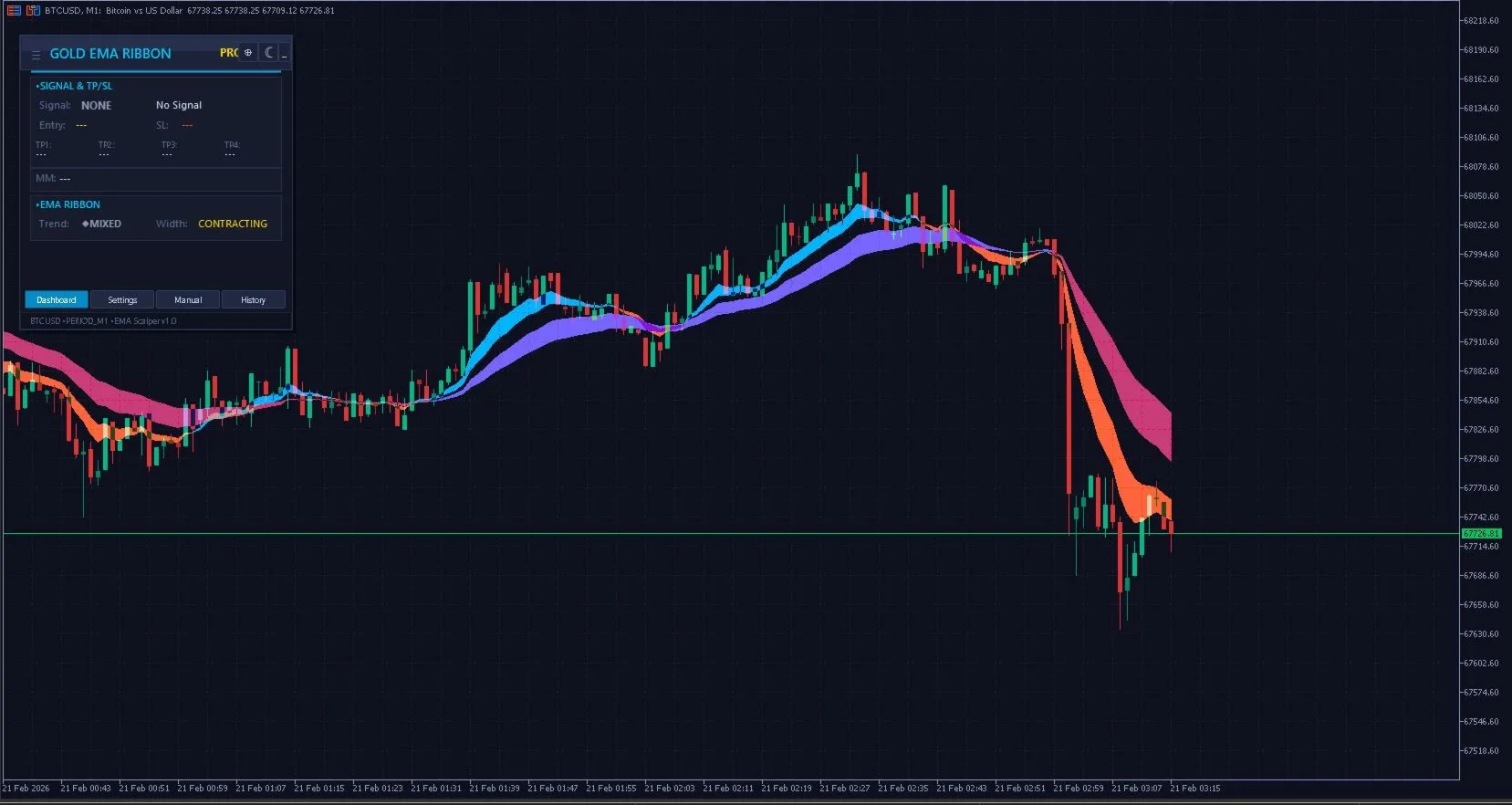
I've been scalping gold for years now, and every year I get the same question: "What's the best scalping setup for XAUUSD?" The honest answer is that there's no universal best - it depends on your risk tolerance, your time zone, and how much screen time you can commit. But I can tell you exactly what I use, why I use it, and how it's evolved into what I run on my charts every single day in 2026.
This isn't a theoretical article. I'm going to walk you through my actual chart setup - the indicators, the settings, the timeframe, the session timing, and the entry/exit rules. Everything you see here is what's on my screen right now.
Why M5 Is the Sweet Spot for Gold Scalping
I've tried everything from M1 to H1 for gold scalping. Here's what I found:
- M1 is too noisy. Gold moves $2-5 on a single M1 candle during London session. You'll get whipsawed constantly, and the spread eats a bigger percentage of your target.
- M15 is too slow for scalping. By the time a signal confirms on M15, you've already missed the first 30-50 pips of the move. It works better for intraday swing trades.
- M5 gives you enough data per candle to filter noise, but fast enough to catch moves as they start. A confirmed M5 candle represents 5 minutes of price action - enough to be meaningful, not so much that you're late.
The key insight about M5 on gold: during active sessions (London/New York overlap), you typically get 2-4 good setups per session. That's enough to be profitable without overtrading. On M1, you'd see 15+ signals, most of them noise. On M15, you'd see 1-2, and missing one means your session is wasted.
The Core: 6-EMA Ribbon Cloud
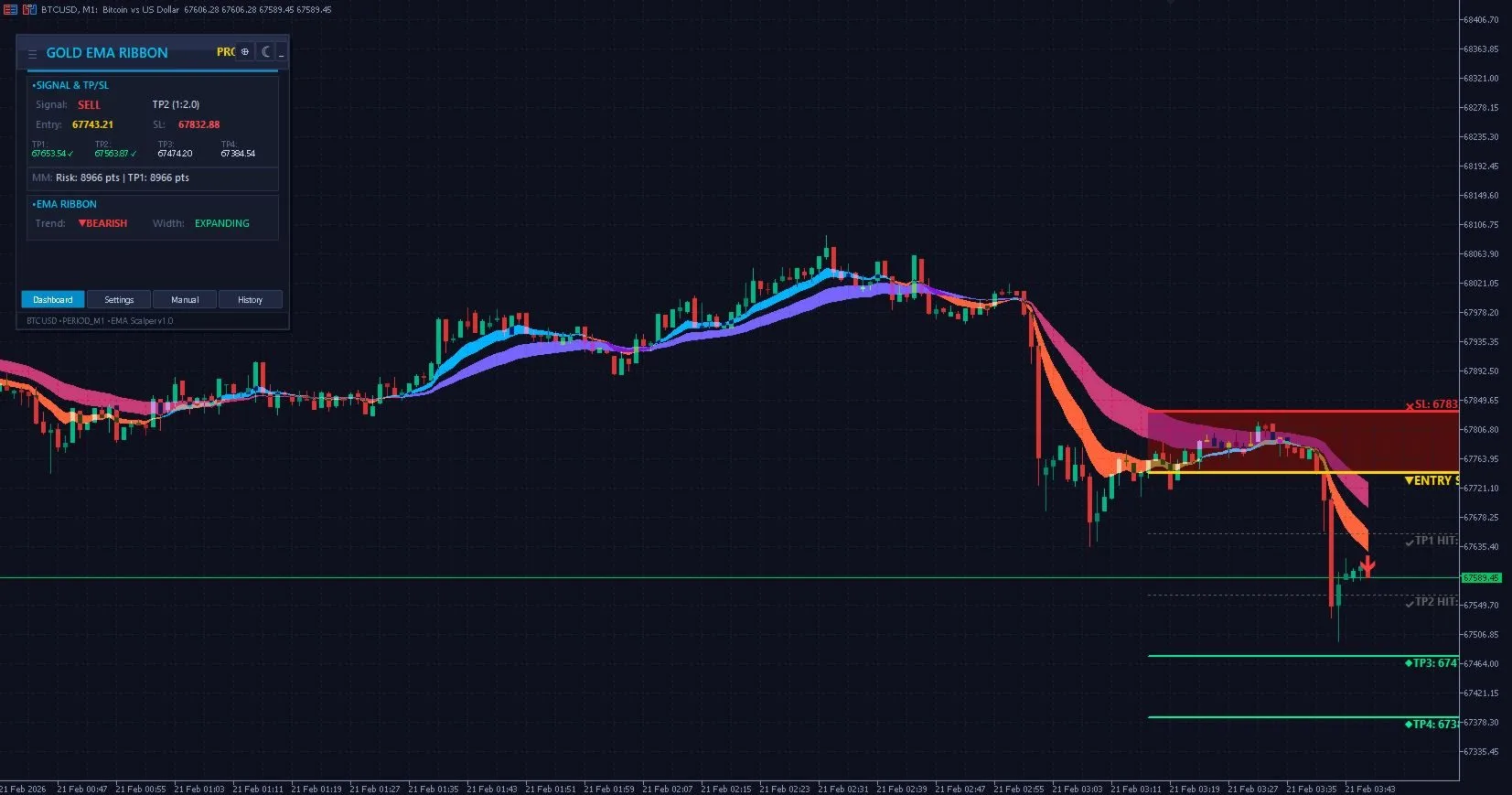
The backbone of my scalping setup is a 6-EMA ribbon. Not a single moving average, not a crossover pair - a full ribbon of six EMAs that gives you visual trend clarity at a glance.
The six periods I use: 8, 13, 21, 34, 55, 89. These follow a Fibonacci-like progression that creates natural spacing between the lines. When the market is trending, these EMAs fan out like a ribbon. When the market is consolidating, they compress and tangle together.
What makes the ribbon superior to a single MA:
- Trend strength is visible - a wide ribbon means strong trend, compressed ribbon means weak or no trend. You don't need an ADX indicator to tell you what your eyes can see.
- Pullback zones are defined - when price pulls back into the ribbon during a trend, it creates natural support/resistance. The fast EMAs (8, 13) act as the first defense, the slow EMAs (55, 89) as the last.
- Trend changes are unmistakable - when all six EMAs flip order, the trend has genuinely changed. Much harder to get faked out compared to a single crossover.
I display the ribbon with a 3-layer cloud fill - fast cloud between EMAs 8-21, mid cloud between 21-55, slow cloud between 55-89. Each layer is color-coded, so I can instantly see which part of the ribbon price is interacting with.
The Signal Engine: When I Actually Enter
Having a pretty ribbon on your chart is useless without entry rules. Here's my signal logic:
Buy signal conditions:
- All 6 EMAs are in bullish order (8 > 13 > 21 > 34 > 55 > 89)
- Price has pulled back to touch or penetrate the fast cloud (EMA 8-21 zone)
- A bullish confirmation candle closes above EMA 8
- The ribbon is expanding - the trend is accelerating, not dying
Sell signal conditions: Mirror image - all EMAs in bearish order, pullback to fast cloud, bearish confirmation candle closes below EMA 8, ribbon expanding downward.
What I specifically avoid:
- Signals when the ribbon is tangled (EMAs crossing each other repeatedly) - this is chop, not trend
- Signals against the higher timeframe direction - if H1 is bearish, I don't take M5 buy signals
- Signals during the first 15 minutes after a major news release - spread widens and price action is erratic
The 4-Level TP System That Changed Everything
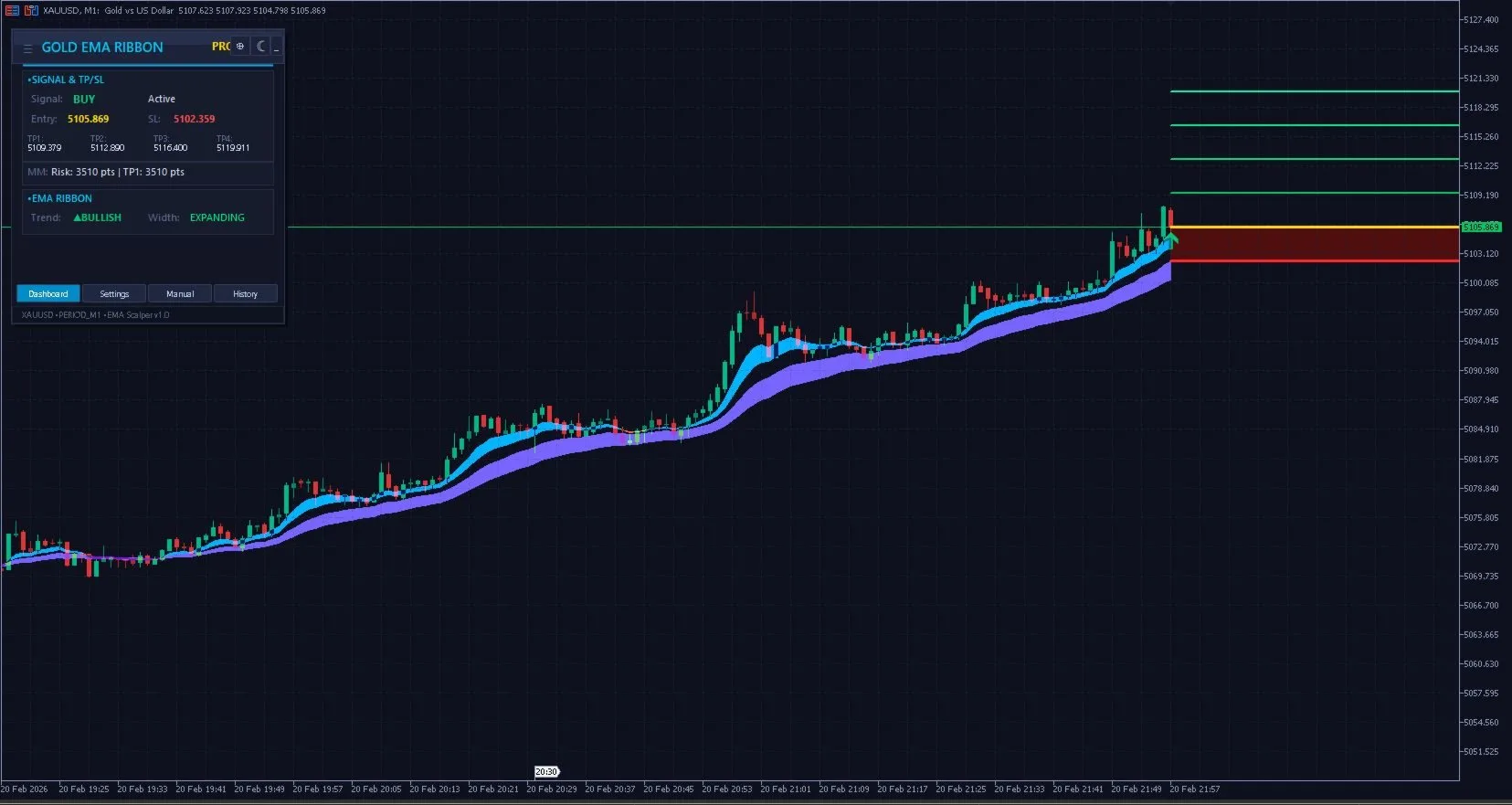
This is where most scalping setups fall apart. They tell you where to enter but have no systematic exit plan. I use a 4-level take profit system built into Gold EMA Ribbon Scalper Pro:
- TP1 - 1.0x ATR from entry. Quick scalp target. I close 40% here.
- TP2 - 1.5x ATR. Another 25% closed. Stop moves to breakeven.
- TP3 - 2.5x ATR. Another 25% closed. Stop is now trailing.
- TP4 - 4.0x ATR. The remaining 10% runner - captures extended moves.
Why ATR-based instead of fixed pip targets? Because gold's volatility changes dramatically throughout the day. During Asian session, ATR on M5 might be 30 pips. During London-New York overlap, it might be 80 pips. Fixed targets would be too tight during volatile sessions and too wide during quiet ones. ATR automatically adjusts.
The practical impact: on a $2,800 gold price with M5 ATR of 50 pips (5.0 points), TP1 sits 50 pips from entry - roughly $5 per 0.01 lot. TP4 at 200 pips would be $20 per 0.01 lot. The 40% at TP1 locks in profit fast, while the runner at TP4 captures the occasional extended move that makes the whole system profitable long-term.
Stop Loss: Where I Place It
My stop loss goes below the slow cloud (EMA 55-89 zone) for buy trades, above it for sell trades. If price has penetrated all six EMAs against my position, the trade idea is invalid.
In practice, this usually works out to about 1.2-1.5x ATR from entry. With the 4-level TP system, my average risk-to-reward on the full position is roughly 1:1.8, which means I need to win about 40% of trades to break even. My actual win rate runs around 55-60% during trending sessions.
Critical rule: I never widen my stop loss after entering. If the market is moving against me faster than expected, that's information - it tells me the setup was wrong. Moving the stop further away just delays an inevitable loss while increasing its size.
Session Timing: When I Trade
I've written about gold trading sessions before, but here's the short version:
- London Open (07:00-10:00 UTC) - primary session. Gold usually establishes a directional bias in the first 1-2 hours. I look for the ribbon to fan out after Asian compression.
- London-NY Overlap (12:00-16:00 UTC) - highest volume, biggest moves. Ribbon signals during this overlap tend to produce the longest runners.
- Asian Session - I almost never scalp during Asia. Moves are too small, spread is wider. The setup needs actual momentum.
The Signal Scoring System
Not all signals are equal. A signal during a strong trend with expanding ribbon is much more reliable than one during a weak trend with compressing ribbon. That's why I built a scoring system into my setup.
Each signal gets graded based on:
- Ribbon expansion rate (EMAs getting further apart?)
- ATR level relative to average (volatility above normal?)
- Position within the session (early London vs late NY)
- Pullback depth (shallow pullback to EMA 8 is stronger than deep pullback to EMA 55)
I only trade the highest-scoring signals. On an average London session, I might see 4-5 signals but only take 2-3 based on scoring. This selective approach keeps my win rate above 55% - taking every signal would drop it to probably 45%.
Heiken Ashi Candles: The Noise Filter
One optional but powerful addition is switching from standard candles to Heiken Ashi. The indicator supports 5 color states - strong bullish, weak bullish, neutral, weak bearish, strong bearish - each with a different color.
I don't always use Heiken Ashi. On quiet days with clean trends, standard candles work fine. But during volatile sessions where regular candles are erratic with long wicks, Heiken Ashi smooths the noise dramatically. You see the trend direction through candle colors rather than trying to interpret individual candle shapes.
The practical benefit: fewer premature exits. A big red candle during an uptrend can panic you into closing. With Heiken Ashi, you see the candle color shift to weak green instead of flipping red, keeping you in the trade until the trend actually turns.
What About Combining This with an EA?
After running this manual setup for months, I eventually automated the core logic into Gold Quantum Scalper AI. The EA uses a similar signal engine but adds features hard to replicate manually - auto-adaptive SL/TP, win-rate lot scaling, and market condition detection.
The manual setup (Gold EMA Ribbon Scalper Pro indicator) is for traders who want to make every decision themselves. The EA is for traders who want disciplined automated execution. I use both - the indicator on my active chart for learning, and the EA on a separate account for consistent hands-off scalping.
My Exact Settings in 2026
For anyone who wants to replicate this setup:
- Chart: XAUUSD, M5 timeframe
- Broker: Any ECN broker with raw spread (I use AMarkets, but IC Markets, Exness, FP Markets all work)
- EMA periods: 8, 13, 21, 34, 55, 89
- Cloud fill: 3-layer gradient (fast/mid/slow)
- Signal mode: On confirmed candle close only
- TP ratios: 1.0 / 1.5 / 2.5 / 4.0 x ATR
- SL: Below/above slow cloud, ~1.2-1.5x ATR
- Session filter: London + New York (07:00-20:00 UTC)
- Max spread: 25 pips (skip signal if spread exceeds this)
These are my personal settings and may need adjustment for your broker and risk tolerance. The principle - EMA ribbon for trend, pullback for entry, multi-level TP for exits - stays the same regardless of specific numbers.
Gold scalping in 2026 is more volatile than ever. Having a systematic setup that adapts to volatility through ATR-based targets rather than using fixed pip values is no longer optional - it's survival.
Common Gold Scalping Mistakes That Kill Accounts
After two years of scalping XAUUSD on M5, I've catalogued the mistakes that cost me the most money early on. Every single one is avoidable:
- Scalping during news events: NFP, CPI, and FOMC releases create 100+ pip candles in seconds. No stop loss is fast enough. I mark news time on my chart and close all positions 5 minutes before. After release, I wait at least 15 minutes for the initial spike to settle before taking new signals.
- Ignoring spread widening: Gold spreads can jump from 15 pips to 50+ pips during low liquidity or news. If your TP is 60 pips and the spread widens to 40, your effective profit target is only 20 pips while your risk stays the same. The EMA Ribbon Scalper has a max spread filter - use it, and set it to 25 pips or lower.
- Revenge trading after a loss: You take a clean loss, then immediately re-enter without waiting for a new signal because "the move has to come back." It doesn't. Each trade must be independent. I enforce a 3-candle cooldown after every loss before taking a new trade.
- Trading all sessions equally: Gold scalping works best during London and New York sessions (07:00-17:00 GMT). Asian session has lower volatility and wider relative spreads. The same setup that generates 3-4 clean signals during London produces only noise during Asian. I either skip Asian entirely or switch to a breakout strategy designed for that session.
- Moving stop losses manually: "I'll give it a bit more room" is how small losses become account-threatening ones. Gold can drop $20 (200 pips) in 10 minutes during a momentum move. If your system says SL at 50 pips, honor it. Automating your trade management with Smart Trade Manager Pro removes this temptation entirely.
My Daily Scalping Routine: Step by Step
Here's exactly what I do each trading day:
- 06:45 GMT - Pre-market check: Open economic calendar. Flag any high-impact events. If NFP or FOMC is today, I either skip gold entirely or only trade the session before/after the release.
- 07:00 GMT - Chart setup: Open XAUUSD M5 chart. Check H1 and H4 EMA ribbon direction for the higher timeframe trend. If H1 and H4 agree (both bullish or both bearish), I only take M5 signals in that direction.
- 07:05 GMT - Mark levels: Identify the Asian session range (the high and low formed between 00:00-07:00 GMT). These become key intraday support/resistance. If price opened London near the Asian high, I'm cautious about longs until a clear breakout.
- 07:15-12:00 GMT - Active trading: Take signals as the Gold EMA Ribbon Scalper Pro generates them. Maximum 3 trades open simultaneously. If I hit 3 consecutive losses, I stop for 30 minutes.
- 12:00 GMT - US pre-market assessment: US futures open at 13:30 GMT. The 12:00-13:30 window is often quiet. I reduce activity or tighten criteria during this period.
- 13:30-17:00 GMT - US session: Volatility picks up again. Some of the best moves happen in the first 90 minutes of US session as London and New York overlap.
- 17:00 GMT - Daily review: Close any remaining positions. Review the day's trades in a journal. Log what worked and what didn't.
Having this routine removes decision fatigue. I don't wonder "should I trade now?" - the schedule tells me. This consistency is what turns a scalping strategy from stressful gambling into a systematic business.
Frequently Asked Questions
What is the best timeframe for gold scalping?
M5 (5-minute) is the sweet spot for most gold scalpers. M1 generates too many false signals and requires sub-second execution. M15 is more of a day-trading timeframe with 2-3 trades per day instead of 5-10. M5 provides enough signals for active trading while filtering out most tick-level noise. I use M5 for entries and exits, with H1 as a trend filter to confirm direction.
How much can you make scalping gold per day?
With a $10,000 account risking 1% per trade, averaging 5 trades per day at 55% win rate with 1.5:1 R:R, you'd expect approximately $75-$125 net profit per day (0.75-1.25% return). Some days you'll make $200+, some days you'll lose $150. The key metric isn't daily P&L - it's monthly consistency. Aim for 5-10% per month and let compounding do the heavy lifting. Anyone promising 5-10% per day is either lying or taking excessive risk.
What spread is acceptable for gold scalping?
Below 20 pips (on a 2-decimal broker) is ideal. 20-30 is acceptable during active sessions. Above 30 pips, most scalping setups become unprofitable because the spread eats too much of your target. ECN/Raw spread accounts typically offer 5-15 pip spreads on gold during London and New York sessions. If your broker consistently charges 40+ pips, switch brokers before you start scalping. The spread is literally your cost of doing business.
Should I scalp gold during Asian session?
Generally no. Asian session (00:00-07:00 GMT) has 40-60% lower volatility than London, which means smaller moves but the same spread. Your risk:reward ratio gets compressed. However, the Asian range does create a valuable setup - the Asian range breakout strategy specifically uses the low-volatility consolidation to identify clean breakout levels for the London open.
Do I need a VPS for gold scalping?
If you're running an automated scalper or EA, yes - a VPS with less than 5ms latency to your broker's server is important. For manual scalping with indicator signals, a VPS isn't necessary as long as your internet connection is stable (below 100ms ping to your broker). Where a VPS becomes critical is for trade management - if Smart Trade Manager Pro is handling your trailing stops and partial TPs, the VPS ensures it runs 24/7 without depending on your home PC staying online.
Can I scalp gold with a $500 account?
Technically yes with 0.01 lot size, but it's extremely tight. A 50-pip stop loss on 0.01 lots risks $5 - that's 1% of $500. Your profit targets would be $7.50-$10 per winning trade. It works mathematically, but psychologically it's challenging. I recommend at least $2,000-$3,000 to scalp gold comfortably. Below that, the minimum lot constraints force you into either too-tight stops (getting stopped by normal volatility) or too-much risk per trade (position sizing issues). Build your account on a larger instrument first, then graduate to gold.
Disclaimer: This article describes my personal trading setup and is not financial advice. Trading gold involves significant risk of capital loss. Past performance does not guarantee future results. Always test on a demo account first.