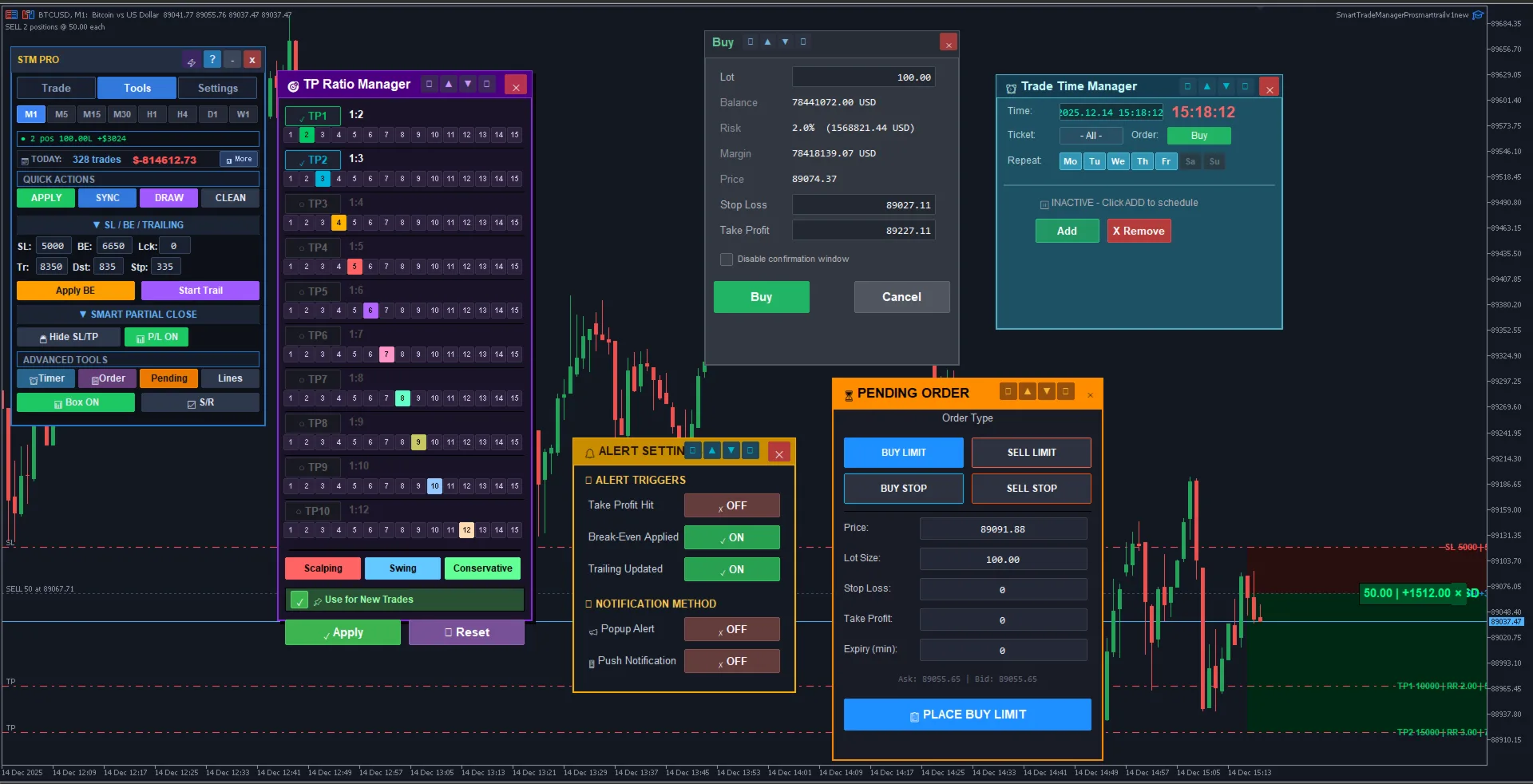
Every gold trader has been there: you enter a perfect setup, price moves $15 in your favor, and you're staring at unrealized profit. Then gold does what gold does - a sharp pullback wipes out most of the move. Your fixed take profit wasn't hit, and now you're back at breakeven wondering why you didn't lock in some of that gain.
The answer is trailing stops. But "use a trailing stop" is vague advice. There are at least five distinct methods, each with different behavior on gold. I've tested all of them extensively, and this article breaks down the pros, cons, and ideal use case for each one.
Method 1: Fixed Distance Trailing Stop
The simplest approach. Once your trade is in profit by X pips, the stop loss follows price at a fixed distance. If you set a 30-pip trailing stop on gold, and price moves $10 in your favor, the stop sits $3 behind the current price (30 pips = 3.0 points on 5-digit gold).
How it works:
- The stop only moves in the direction of profit - never backwards
- As price advances, the stop ratchets up (for longs) or down (for shorts)
- If price reverses by more than 30 pips from the local high, the trade closes
Pros:
- Dead simple to understand and configure
- Works well in smooth trends with consistent momentum
- No calculations needed - one parameter to set
Cons:
- Gold doesn't trend smoothly. It spikes, pulls back, spikes again. A 30-pip trail gets clipped on normal pullbacks during strong trends.
- The distance is arbitrary. 30 pips means something completely different during Asian session (when volatility is 20 pips per candle) vs London-NY overlap (when volatility is 80 pips per candle).
When I use it: Almost never on gold. The volatility profile makes fixed distances unreliable. I do use it on calmer forex pairs like EURUSD or AUDUSD where move structure is more predictable.
Method 2: ATR-Based Trailing Stop
Instead of a fixed pip distance, the trailing distance equals a multiple of the current Average True Range (ATR). If 14-period ATR on gold M5 is 50 pips, and you use 1.5x ATR, the trailing distance is 75 pips. During quiet hours when ATR drops to 25, the trail tightens to 37.5 pips.
How it works:
- ATR is recalculated on every candle close
- The trailing distance dynamically adjusts to current volatility
- During high-volatility sessions, the trail widens - giving the trade more room
- During low-volatility periods, the trail tightens - locking profits faster
Pros:
- Adapts to gold's changing volatility throughout the day
- Reduces premature exits during volatile sessions
- Tightens automatically during quiet periods when the trend is likely dying
Cons:
- ATR can suddenly spike (news event), widening the trail right when you might want it tight
- Requires understanding of ATR periods and multipliers - more parameters to tune
When I use it: This is my primary trailing method for gold scalping. The 1.5x ATR distance survives normal gold pullbacks while still being tight enough to protect profits. I've written about using ATR-based trailing in the context of exit strategies - it's the best general-purpose approach for gold.
Method 3: Step Trailing Stop
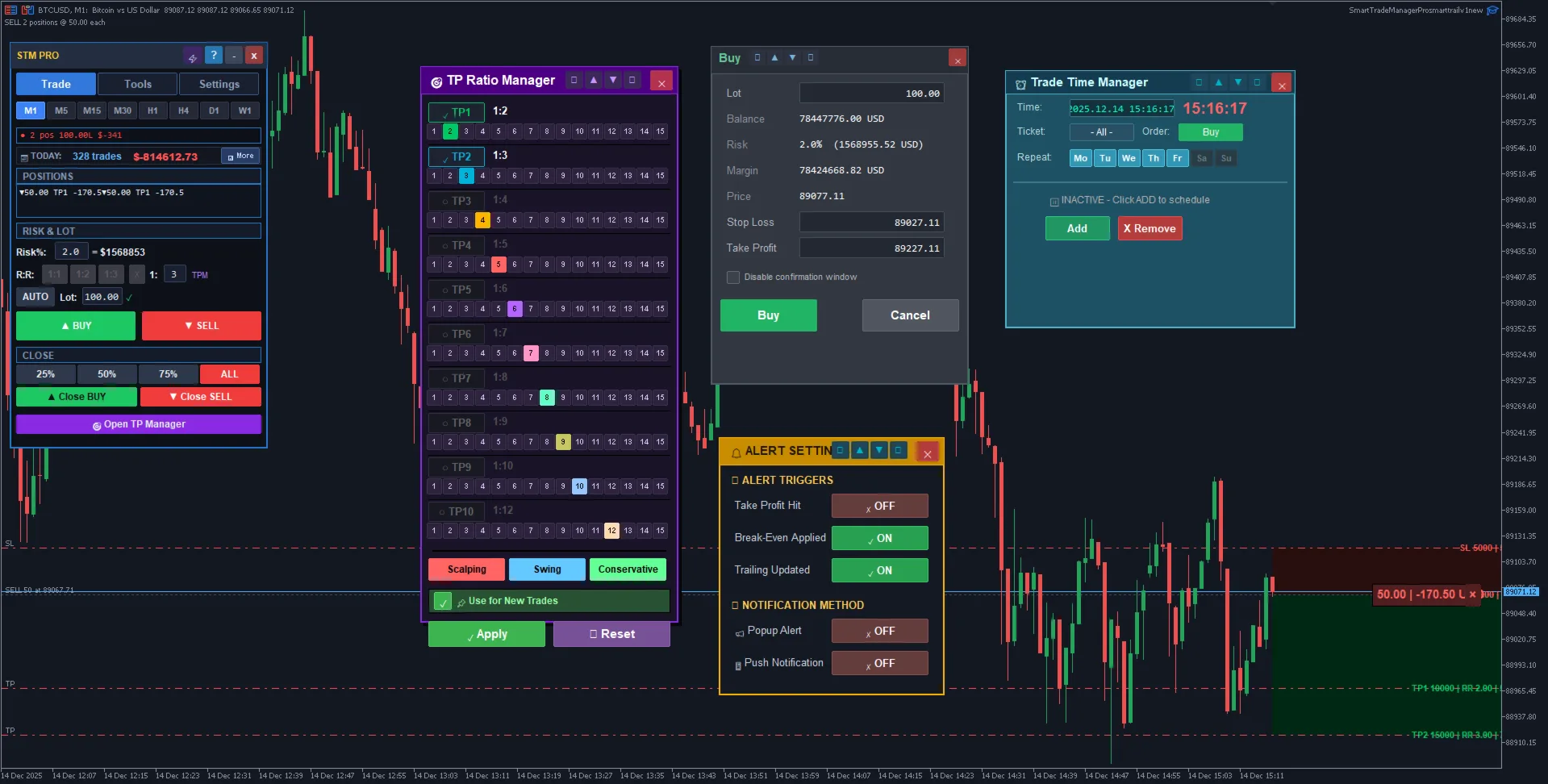
A refinement of fixed trailing: instead of continuously following price, the stop moves in discrete steps. You define three parameters: trailing start (when to begin trailing), trailing distance (how far behind price), and trailing step (minimum price movement before the stop moves).
Example: Start = 250 points, Distance = 30 points, Step = 10 points. After the trade is 250 points ($25/lot) in profit, the stop begins trailing 30 points behind. But it only moves when price advances by at least 10 more points. This prevents the stop from constantly adjusting on every tick.
Pros:
- Smoother stop movement - doesn't react to every minor price fluctuation
- Step size can be tuned to the instrument - larger steps for volatile gold, smaller for calm pairs
- The delayed start means the trade has room to work before trailing even begins
Cons:
- The step mechanism can leave money on the table during sharp reversals - the stop might be one step behind where it should be
- Three parameters to configure instead of one
When I use it: For gold trades that have already reached profit. I combine step trailing with the multi-TP system in Smart Trade Manager Pro - after TP3 is hit, the remaining runner uses step trailing with a 30-point distance and 10-point step. This balances profit protection with room for the move to extend.
Method 4: Breakeven + Trail (The Two-Phase Approach)
This is the most popular method among professional gold traders, and for good reason. It splits trade management into two distinct phases:
Phase 1 - Breakeven: When price reaches a trigger level (e.g., 150 points in profit), the stop loss moves to entry price (or entry + small lock like 5 points). Risk on the trade drops to zero.
Phase 2 - Trail: After hitting a higher profit threshold (e.g., 250 points), the trailing stop activates and begins following price.
Pros:
- Zero-risk on the trade after Phase 1 - even if the trailing stop eventually gets hit, worst case is breakeven or a tiny profit
- Psychological relief - once at breakeven, you can hold the trade with zero stress
- The gap between BE trigger and trail start gives the trade room to breathe
Cons:
- Aggressive BE triggers (e.g., moving to BE after only 50 points of profit) cause frequent breakeven exits on gold. The natural pullback after an initial spike often returns to entry before continuing.
- You can get "broken even" out of a trade that goes on to make 300 points. This is the #1 frustration gold traders report.
When I use it: Always. This is my core trade management framework. The key is setting the BE trigger far enough from entry - I use 150 points (15 pips on 5-digit gold, roughly $15/lot), which is far enough to survive most pullbacks. The trailing phase starts at 250 points. Between 150 and 250 points of profit, the stop sits at breakeven, giving the trade room to develop.
Method 5: TP-Triggered Trailing (My Favorite for Gold)
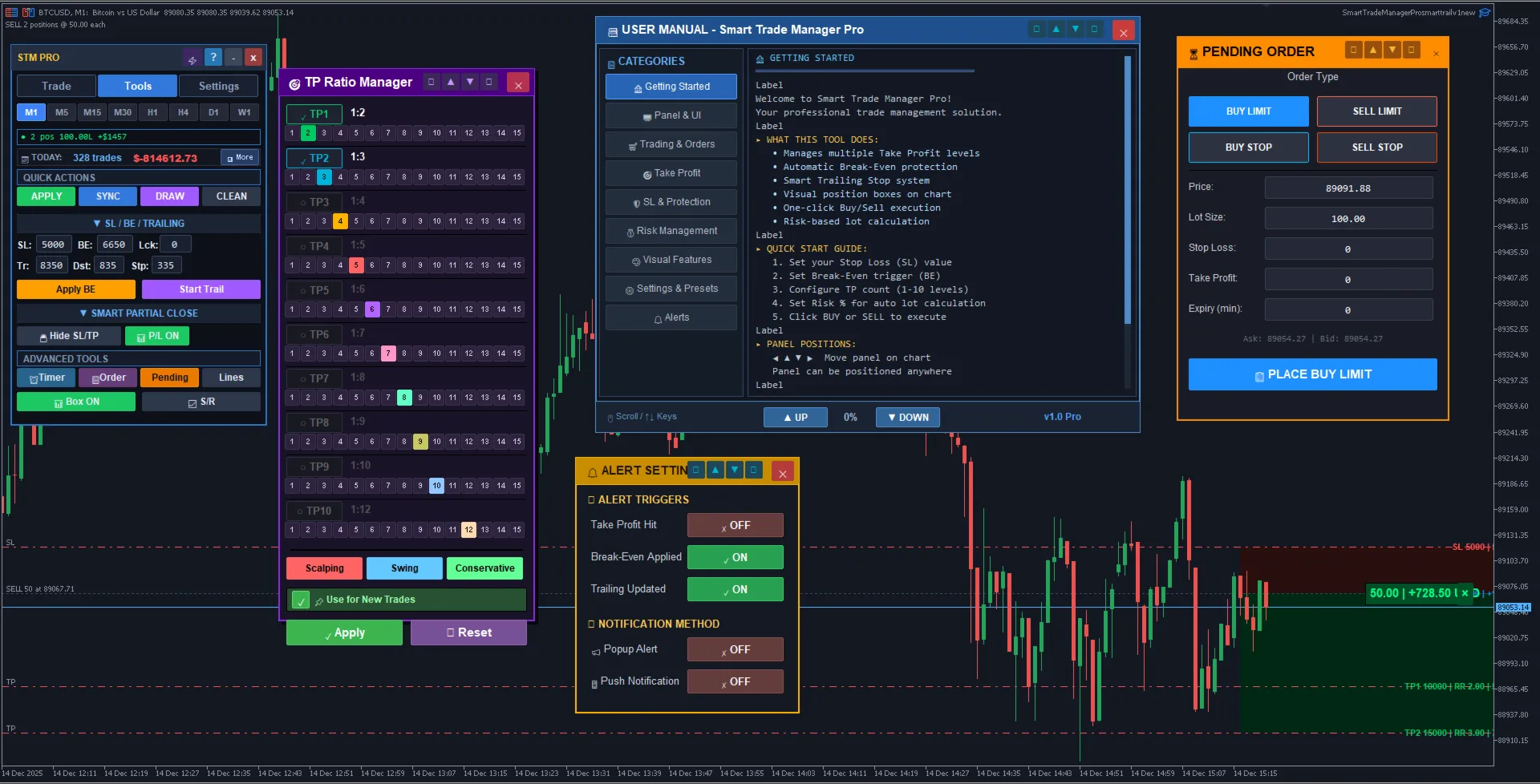
This is the method I've settled on after extensive testing. Instead of trailing from the start, the trailing stop only activates after a specific take profit level is hit.
The setup with Smart Trade Manager Pro's multi-TP ladder:
- TP1 (100 points): Close 25% of position. Action: None (stop stays at original SL).
- TP2 (170 points): Close 25% of position. Action: Move stop to breakeven.
- TP3 (240 points): Close 25% of position. Action: Start trailing stop on remaining 25%.
- Runner (remaining 25%): Riding with step trailing, distance 30 points, step 10 points.
Why this is superior for gold:
- No premature trailing. The first 240 points of the move are managed by the 3-level TP system with fixed targets. The trailing only begins after 75% of the position is already locked in. This eliminates the "trailed out too early" problem.
- Progressive risk reduction. After TP1: 25% profit locked, risk still at SL. After TP2: 50% locked, stop at BE. After TP3: 75% locked, trailing starts. At no point are you trailing your full position - only the small runner.
- Optimal for gold's spike-pullback pattern. Gold typically spikes, pulls back 30-50%, then continues. The TP system catches the spike. The trailing captures the continuation. The combination catches both phases.
The Numbers: How Each Method Compares
From my experience running these methods on XAUUSD M5 during London and New York sessions:
- Fixed 30-pip trail: Average trade captures ~40% of the total move. Frequent early exits on pullbacks.
- ATR 1.5x trail: Captures ~55% of moves. Better during volatile sessions. Occasionally gives back too much during quiet transitions.
- Step trail (30 dist, 10 step): Captures ~50%. Smoother P&L curve but misses some sharp reversals.
- BE + Trail: Captures ~60% when triggers are properly set. Many trades exit at BE during pullbacks if trigger is too aggressive.
- TP-triggered trail: Captures ~65-70% of available profit across the full position (including the partial closes). The highest total capture because it combines fixed targets for the bulk of the position with adaptive trailing for the runner.
The caveat: these numbers depend entirely on settings. A poorly-configured ATR trail will underperform a well-configured fixed trail. The method matters less than the execution.
Settings I Use for Smart Trade Manager Pro
My exact configuration for XAUUSD scalping:
- Initial SL: 200 points (20 pips, ~$20/lot)
- BE Trigger: 150 points
- BE Lock Profit: 0 points (move to exact entry)
- Trail Start: 250 points
- Trail Distance: 30 points
- Trail Step: 10 points
- Trail After TP: Yes, start after TP3
- TP1: 100 points, close 25%, no action
- TP2: 170 points, close 25%, move to BE
- TP3: 240 points, close 25%, start trail
- Max Spread: 200 points (skip management if spread exceeds)
The manager works with any entry method - manual trades, signals from Gold EMA Ribbon Scalper Pro, Gold Session Sniper Pro, or even trades from an EA like Gold Quantum Scalper AI. It manages trades by magic number filter, so you can run it alongside any indicator or EA without conflicts.
The Biggest Mistake: Trailing Too Tight
If there's one takeaway from this article, it's this: gold needs room to breathe. A 10-point trailing distance on an instrument that regularly pulls back 50 points is not a trailing stop - it's a fast exit button.
The average M5 candle range on XAUUSD during London session is 40-60 pips. That means every single candle can contain a 40-point pullback from wick high to close. If your trailing stop is 30 points, you will get stopped on basically every normal candle fluctuation.
Scale your trailing parameters to the instrument's volatility. For gold, minimum trailing distance should be around 30-50 points during active sessions. During Asian session (lower volatility), you can tighten to 20-30. This is exactly why ATR-based trailing is my general recommendation - it does this scaling for you.
Session-Based Trailing Stop Adjustments
Gold's volatility profile changes dramatically throughout the 24-hour trading day, and your trailing stop strategy should reflect this:
- Asian Session (00:00-07:00 GMT): Average M5 candle range drops to 15-25 pips. Tighten trailing distance to 20-30 points. Use a tighter ATR multiplier (1.2x instead of 1.5x) or switch to candle-close trailing. The risk here is premature exit from trades that will eventually move - but that move happens during London, not now.
- London Open (07:00-09:00 GMT): Volatility spikes. Average M5 range jumps to 40-60 pips. Widen trailing to 40-50 points or 1.5-2x ATR. This is where the biggest moves initiate. You want to ride the momentum, not get shaken out by the first pullback.
- London-New York Overlap (13:30-16:00 GMT): Peak daily volatility. M5 ranges can hit 50-80 pips. Use your widest trailing parameters here - 2x ATR or 50+ fixed points. Trades that catch the overlap move can deliver 150-300+ pip runs if you trail correctly.
- Late US Session (17:00-21:00 GMT): Volatility fades. Tighten trailing back to Asian levels. Any open positions should be trailed aggressively - the major move is likely over, and you're protecting remaining profit.
If manually adjusting sounds exhausting - it is. This is precisely why I built session-aware logic into my trade management workflow. The Smart Trade Manager Pro handles multi-TP levels and trailing automatically, so I don't have to watch every candle.
Trailing Stop Mistakes That Erase Winning Trades
The worst feeling in trading isn't a clean loss - it's watching a winning trade turn into a loss because your trailing stop was wrong. Here are the specific mistakes I see repeatedly:
- Moving to breakeven too early: If you move SL to entry after the first 30 pips of profit, you'll get stopped at zero on 60%+ of your trades because gold routinely pulls back 20-30 pips before continuing. Wait until at least TP1 (60-80 pips) before considering breakeven.
- Using the same trailing distance for every session: A 30-point trail during London overlap is reasonable. During Asian session, it's too wide (you'll give back all your gains). During NFP, it's suicide (a single candle exceeds it). Adapt to conditions.
- Trailing on every tick instead of candle closes: Tick-based trailing follows every micro-fluctuation. A wick high that lasts 0.3 seconds triggers your trail, then price retreats and hits the new stop. Candle-close trailing only updates at the close of each completed M5 candle, ignoring intrabar noise.
- Never trailing at all: Some traders set a fixed TP and SL and walk away. This works fine for runners that hit TP3, but it means you always exit at the same spot regardless of momentum. On days when gold trends 500+ pips, a fixed TP of 100 leaves 400 pips on the table. Trailing captures those exceptional runs.
Frequently Asked Questions
What is the best trailing stop method for gold?
ATR-based trailing with a 14-period ATR and 1.5x multiplier on M5 timeframe is my default recommendation. It automatically adapts to gold's volatility - widening during high-volatility sessions (London, New York) and tightening during quiet periods (Asian). Combined with a multi-TP system that locks in partial profits at fixed levels, this approach balances profit protection with the ability to ride extended moves.
When should I move my stop loss to breakeven on gold trades?
After hitting TP1 (your first partial take-profit level). For my setup, that's typically 60-80 pips of profit. Moving to breakeven before this point results in getting stopped at zero on too many trades that would have eventually been winners. If you're using a 3-TP system, take 40% off at TP1, then move the stop to entry. The remaining 60% of the position rides with trailing.
How many pips should my trailing stop be on XAUUSD?
It depends on the session and your timeframe, but for M5 scalping during London: 40-50 points (measured in the last digit of a 2-decimal quote) is typical. During Asian session: 20-30 points. If using ATR-based trailing, set it to 1.5x the 14-period ATR and it calculates the right distance automatically. Never trail tighter than 20 points on gold - the normal bid-ask noise will stop you out constantly.
Should I use partial take-profit or trail the full position?
Partial TP combined with trailing is mathematically superior. Taking 30-40% at TP1 locks in guaranteed profit, reduces psychological pressure, and lets the remainder run with trailing. In my testing, a 3-TP system (40% at TP1, 30% at TP2, 30% trailed) produces 15-20% more total profit over 500+ trades compared to trailing the entire position with no partials. The key insight: partial TP reduces variance while trailing captures outlier moves.
Does Smart Trade Manager Pro work with any gold EA?
Yes. Smart Trade Manager Pro manages trades by magic number, so it can handle exits for any EA that places trades on XAUUSD. Set the magic number in the utility to match your EA's magic number, configure your TP levels and trailing method, and it takes over exit management. This is especially useful for EAs that have good entries but basic exit logic - the utility upgrades their trade management without modifying the EA's code.
Is a fixed trailing stop ever better than ATR-based?
In specific conditions, yes. During strongly trending markets with consistent momentum (like gold rallies driven by geopolitical events), a fixed trailing stop of 50-60 points can outperform ATR-based trailing because ATR can widen during high-volatility trends, causing you to give back more profit on reversals. However, for general daily trading across different market conditions, ATR-based trailing is more robust because it adapts automatically. I use fixed trailing as an override only when I identify a clear momentum day.
Disclaimer: This article describes my personal trade management approach and is not financial advice. Performance figures are from personal experience and may not be replicated. Trading gold involves significant risk. Always test extensively on a demo account.