I've talked to hundreds of gold traders at various skill levels, and the number one account killer isn't bad entries. It's wrong position sizing. A perfectly good trade with 2x the correct lot size turns a manageable loss into a blow-up. A winning streak with inconsistent sizing means your biggest loss always seems to happen on your biggest position.
This guide covers everything about sizing gold positions correctly: the formulas, the MT5 specifics for XAUUSD, the common mistakes, and how to automate the calculation so you never have to do mental math while the London session is flying.
Understanding XAUUSD Lot Sizes and Pip Values
Before you can size positions, you need to understand how gold is quoted and what lots mean:
- Standard lot (1.0) = 100 ounces of gold. At $2,800/oz, a 1.0 lot position is worth $280,000.
- Mini lot (0.1) = 10 ounces = $28,000 position value.
- Micro lot (0.01) = 1 ounce = $2,800 position value.
Pip value on XAUUSD:
Most brokers quote XAUUSD with 2 decimal places (e.g., 2800.50), making 1 pip = $0.01 movement. Some use 5-digit pricing (2800.500), where 1 pip = $0.001. You need to know which your broker uses.
- 2-digit broker: 1 pip = $0.01 per ounce. Standard lot (100 oz): $1.00 per pip. A 200-pip SL = $200 risk per standard lot.
- 5-digit broker: 1 point = $0.001 per ounce. Standard lot (100 oz): $0.10 per point. A 200-point SL = $20 risk per standard lot.
This is where confusion starts. When I say "200 pips" in this article, I'm using 2-digit convention. On a 5-digit broker, that's 2000 points. Always confirm with your broker's contract specification (right-click the symbol in MT5 -> Specification).
The Position Sizing Formula
The core formula for calculating lot size based on risk:
Lot Size = (Account Balance x Risk %) x (SL in Points x Tick Value)
Where:
- Account Balance: Your current account equity (e.g., $5,000)
- Risk %: The percentage you're willing to risk per trade (e.g., 1% = 0.01)
- SL in Points: Your stop loss distance in broker points (e.g., 200 points on 5-digit)
- Tick Value: The dollar value of one point movement for one lot (varies by broker - typically $0.10 per point per lot for 5-digit, or $1.00 per pip per lot for 2-digit)
Real Examples: Calculating Lot Size for Gold
Example 1 - Conservative scalper:
- Account: $5,000
- Risk per trade: 1% = $50
- Stop loss: 200 points (20 pips on 2-digit, or $20 move)
- Tick value: $1.00 per pip per standard lot (2-digit broker)
- Lot size = $50 x (20 pips x $1.00) = $50 x $20 = 2.50 micro lots (0.025 standard lots)
Example 2 - Aggressive intraday:
- Account: $10,000
- Risk per trade: 2% = $200
- Stop loss: 300 points (30 pips = $30 move)
- Lot size = $200 x (30 x $1.00) = $200 x $30 = 6.67 micro lots (0.067 standard lots)
Example 3 - Small account:
- Account: $500
- Risk per trade: 1% = $5
- Stop loss: 200 points (20 pips = $20 move)
- Lot size = $5 x (20 x $1.00) = $5 x $20 = 0.25 micro lots (0.0025 standard lots)
- Problem: most brokers have a minimum of 0.01 lot. At 0.01, your risk is $20 x $500 = 4% per trade - too high for a $500 account with a 200-point SL.
This last example illustrates an important reality: small accounts can't properly scalp gold with standard stop loss distances. Either the SL must be very tight (increasing loss frequency) or the risk percentage exceeds safe limits.
The 1% Rule and When to Break It
The standard advice is to risk 1% per trade. This means 100 consecutive losses to blow your account - practically impossible. But is 1% always right?
- For beginners: 0.5-1% per trade. You're still learning, and your win rate is unstable. Keeping risk low gives you the longevity to learn from mistakes.
- For experienced scalpers with proven edge: 1-2% per trade. If your win rate is consistently above 55% and your R:R is above 1:1.5, you can afford slightly more risk.
- For A+ setups: I occasionally go to 2% on signals with the highest confluence scores. But never above 2%. The moment you risk 5%+ per trade, you're gambling, not trading.
- For EAs: Use the EA's recommended lot sizing. For Gold Quantum Scalper AI, the win-rate lot scaling feature automatically adjusts position size based on recent performance - increasing after winning streaks and reducing after losing streaks.
Account-Based vs Risk-Based Lot Sizing
Two philosophies exist:
Account-based (fixed lot): Always trade the same lot size regardless of stop loss distance. Example: always trade 0.05 lots on a $5,000 account.
Risk-based (variable lot): Lot size changes based on stop loss distance so that dollar risk stays constant. Wider SL = smaller lot. Tighter SL = larger lot.
Risk-based is mathematically superior. Here's why:
With fixed 0.05 lots, a 100-point SL risks $50, but a 300-point SL risks $150. Your risk triples just because the trade setup required a wider stop. That's not intentional risk management - it's accidental.
With risk-based sizing at 1% ($50 target risk), the 100-point SL uses 0.05 lots ($50 risk), while the 300-point SL uses 0.017 lots ($51 risk). Both trades risk the same dollar amount. Every loss feels the same to your account - whether the SL was tight or wide.
Automating Lot Calculation in MT5
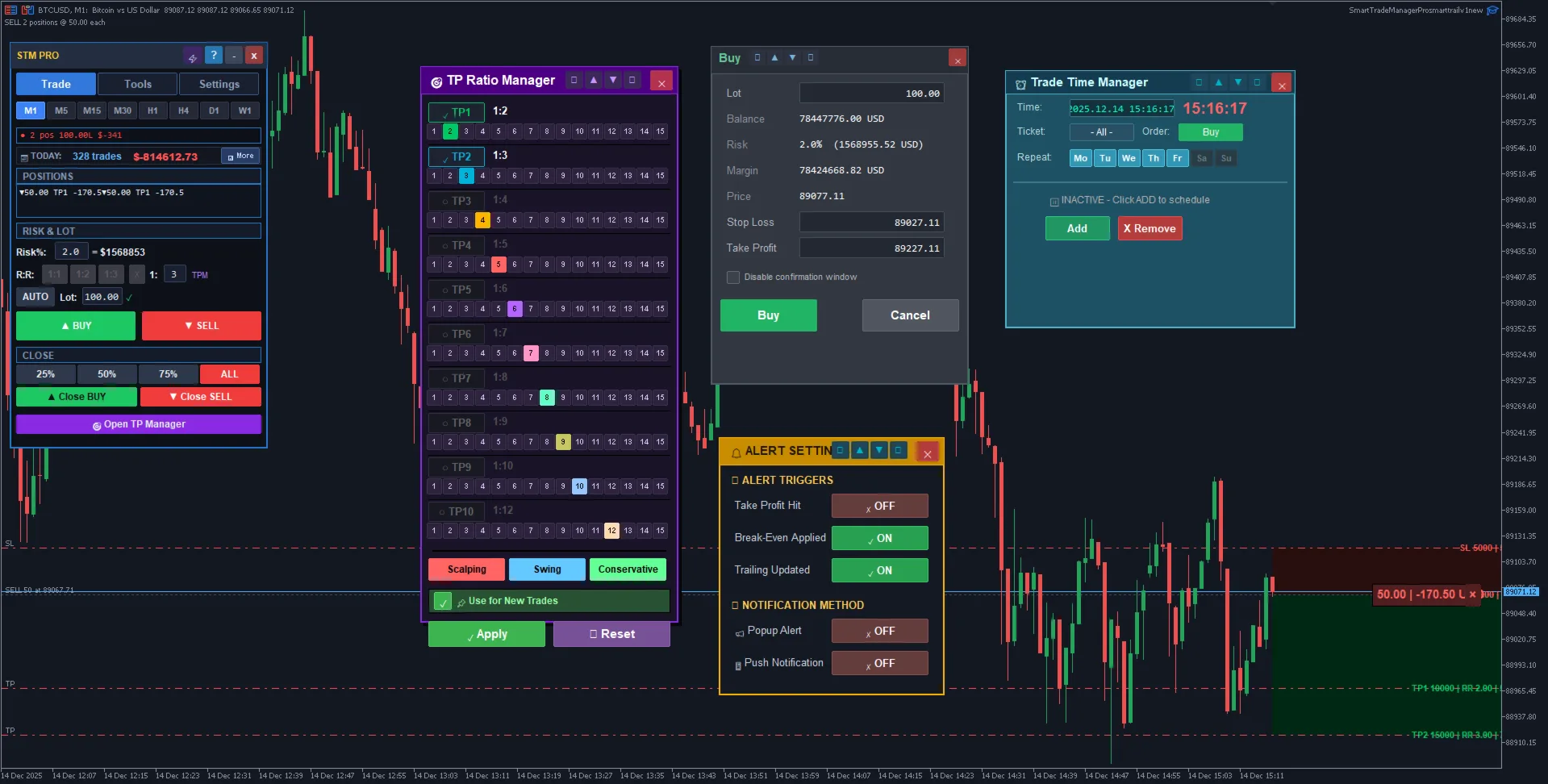
Calculating lot size manually under time pressure at London open is a recipe for errors. I use the auto lot calculator in Smart Trade Manager Pro which automatically:
- Reads the current account balance/equity
- Applies the configured risk percentage
- Measures the distance from entry to SL in points
- Looks up the symbol's tick value and contract size
- Calculates the correct lot size
- Rounds to the nearest valid lot step (0.01 for most gold brokers)
The calculator respects the max spread filter - if spread exceeds the threshold, it won't calculate (preventing entries at bad times). It also accounts for leverage and margin requirements, warning you if the calculated lot size would use more than a set percentage of your free margin.
Position Sizing for Multi-TP Trades
When using a multi-TP ladder (like 3-level TP where you close 33% at each level), position sizing gets slightly more complex:
Calculate your lot size based on total risk as normal. Then ensure the lot size is divisible by 3 (or however many TPs you use). If you calculate 0.07 lots, you can't split it evenly into 3 TPs with 0.01 minimum lot. You'd use either 0.06 (3 x 0.02) or 0.09 (3 x 0.03).
Smart Trade Manager Pro handles this automatically - it calculates the partial close amount at each TP level based on your configured percentages (25%, 25%, 25%, 25% runner for a 4-TP setup).
Common Position Sizing Mistakes
- Using the same lot size for gold as forex. A 20-pip SL on EURUSD risks ~$2/micro lot. A 20-pip SL on gold risks ~$20/micro lot. Gold pip values are roughly 10x higher than major forex pairs. Traders who switch from forex to gold without adjusting lot size blow accounts fast.
- Risking more after a winning streak. "I'm up $500 this week, let me trade 5x bigger." Then the inevitable losing trade erases the week's gains and more. Keep risk percentage constant.
- Not accounting for correlation. If you have 3 open gold trades (maybe different strategies), you're effectively 3x exposed to the same instrument. Your total gold risk should stay within your risk limits - don't treat each trade independently.
- Ignoring swap costs on overnight positions. Gold swap rates are often negative for both long and short positions. On large positions held for days, swap costs can significantly eat into profits. Factor this into your overall risk.
- Moving SL wider without adjusting lot size. You entered with 0.05 lots and a 200-point SL (risking $100). Then you move the SL to 400 points because the trade is "about to turn." Now you're risking $200 - double your intended risk. If you widen the SL, you must also reduce the lot size.
My Position Sizing Rules for Gold
The rules I follow every session:
- Maximum risk per trade: 1% of equity (2% on A+ only)
- Maximum total exposure: 3% of equity across all open positions
- Minimum lot: 0.01 (if calculated lot would be less, I skip the trade - account too small for the SL distance)
- Maximum lot: 5% of free margin (even if risk calculation allows more, I cap it)
- Auto lot calculation: always, no mental math
- Round down: if calculated lot is 0.037, I use 0.03 (not 0.04). Always err on the side of less risk.
Position sizing isn't exciting. Nobody posts their lot size calculator on social media. But it's the one thing that separates traders who survive from traders who blow up. Every blown account I've ever analyzed had the same root cause: too big per trade. Get the sizing right, and your strategy has the time and space to work.
Position Sizing Quick Reference Table for Gold
Here's a quick reference for XAUUSD lot sizes at 1% risk on a 2-digit broker ($1 per pip per lot):
$1,000 Account (1% = $10 risk):
- 10-pip SL: 0.10 lots | 20-pip SL: 0.05 lots | 30-pip SL: 0.03 lots | 50-pip SL: 0.02 lots
$5,000 Account (1% = $50 risk):
- 10-pip SL: 0.50 lots | 20-pip SL: 0.25 lots | 30-pip SL: 0.17 lots | 50-pip SL: 0.10 lots
$10,000 Account (1% = $100 risk):
- 10-pip SL: 1.00 lots | 20-pip SL: 0.50 lots | 30-pip SL: 0.33 lots | 50-pip SL: 0.20 lots
$25,000 Account (1% = $250 risk):
- 10-pip SL: 2.50 lots | 20-pip SL: 1.25 lots | 30-pip SL: 0.83 lots | 50-pip SL: 0.50 lots
Remember: these assume your broker quotes XAUUSD with 2 decimal places. For 5-digit brokers, multiply the SL distance by 10 (a "20-pip SL" becomes 200 points). The lot sizes remain the same because the pip value calculation adjusts accordingly.
Drawdown Recovery Math: Why Small Losses Matter
The mathematical reason proper position sizing matters becomes clear when you look at drawdown recovery:
- 10% drawdown: Need 11% gain to recover - manageable
- 20% drawdown: Need 25% gain to recover - still possible
- 30% drawdown: Need 43% gain to recover - getting difficult
- 50% drawdown: Need 100% gain to recover - extremely hard, you need to double your remaining account
- 70% drawdown: Need 233% gain to recover - virtually impossible without changing strategy entirely
At 1% risk per trade, even a devastating 10-loss streak only creates a ~10% drawdown (slightly less due to compounding). That's fully recoverable with 12-15 winning trades at normal R:R. At 5% risk per trade, 10 consecutive losses create a ~40% drawdown - requiring 67% gains to recover. This is why the difference between 1% and 5% risk isn't 5x - it's the difference between a recoverable setback and an account-threatening crisis.
The trailing stop strategy you use also affects effective risk. A multi-TP system that locks in partial profits at TP1 and moves to breakeven after TP2 means many trades that initially risked 1% end up risking 0% by the time they close - because the stop has moved to breakeven or better.
Frequently Asked Questions
How do I calculate lot size for gold in MT5?
Use this formula: Lot Size = (Account Balance x Risk %) x (Stop Loss in Pips x Pip Value per Lot). For a $5,000 account at 1% risk with a 20-pip stop loss and $1/pip/lot value: 0.025 lots = ($5,000 x 0.01) x (20 x $1). You can find your broker's pip value by right-clicking XAUUSD in MT5 -> Specification -> "Tick value." Alternatively, use an auto lot calculator like the one in Smart Trade Manager Pro to calculate automatically.
What is the pip value for XAUUSD?
It depends on your broker's decimal places. On a 2-decimal broker (e.g., 2800.50), 1 pip = $0.01, and a standard lot (100 oz) has a pip value of $1.00. On a 5-decimal broker (e.g., 2800.500), 1 point = $0.001, and a standard lot has a point value of $0.10. The important thing is to check your broker's contract specification - right-click the symbol in MT5 and select "Specification" to see tick size and tick value.
Is 1% risk per trade enough for gold scalping?
Yes, 1% is ideal for most gold traders. With a 55-60% win rate and 1.5:1 R:R (achievable with an EMA ribbon scalping setup), risking 1% per trade generates steady account growth while surviving inevitable losing streaks. Even 10 consecutive losses (a 0.01% probability event at 55% win rate) only creates a ~10% drawdown. Experienced traders with proven edge may go to 2% on A+ setups, but higher than that turns trading into gambling.
How many gold trades can I have open at once?
My rule is maximum 3% total exposure across all open positions. If each trade risks 1%, that's 3 simultaneous trades maximum. But remember: multiple gold trades on the same instrument are fully correlated. If gold drops $30 unexpectedly, ALL your gold longs lose simultaneously. For true diversification, spread your open positions across different instruments using a multi-symbol scanner to find uncorrelated opportunities.
Should I use balance or equity for position sizing?
Use equity (account balance minus/plus unrealized P&L from open trades). If your balance is $10,000 but you have open losses of $2,000, your equity is $8,000 - and 1% of $8,000 ($80) is the correct risk for the next trade. Using balance would oversize relative to your actual available capital. Most auto lot calculators let you choose between balance and equity - I always use equity.
What's the minimum account size to scalp gold properly?
With most brokers requiring 0.01 minimum lot, and a 20-pip stop loss on gold costing $20 per 0.01 lot, you need at least $2,000 to risk 1% per trade ($20 risk = 1% of $2,000). Below $2,000, the minimum lot size forces you into 2%+ risk per trade, which is too aggressive. If your account is smaller, either use a cent account (some brokers offer 0.001 lot minimums), trade a wider SL with even smaller lots, or consider instruments with lower pip values until you've built up capital.
Disclaimer: This article is educational content about risk management and is not financial advice. Lot sizes and risk percentages are examples - adjust for your personal circumstances and risk tolerance. Trading XAUUSD involves significant risk of capital loss. Always verify pip values and contract specifications with your specific broker.